
Beware the Soros zombies

what the hell are you talking about? You comments shows you really don't understand this subject at all. When economists and commentators speak of tax cuts... we speak about tax rates... being lowered

Let me give you a primer.

after the rates were cut but melon, kennedy, reagan and bush, revenues went up to new highs within about 2 years.

consequently the only way to say they did not pay for themselves is to use hypothetical rates of growth and non reality based models.

Since I have shown you the revenue increases with links to the govt numbers in the past. this time I will give you a link to a website which adds some commentary. .


Tax revenues going up and taxes paying for themselves are not synonymous. For the 51st time. Let me explain it to you in baby terms so that even you will understand. If tax cuts total $5 but the resulting tax revenue increases over the previous year by only $2, then there is a negative effect of $3. See? The those tax cuts didn't pay for themselves even though revenues went up. This is what history has shown for the most part and what Greenspan was saying. All better now?
 
Last edited:
https://startthinkingright.wordpres...revenues-they-have-always-increased-revenues/


Furthermore, Mellon was also vindicated in his astonishing predictions that cutting taxes across the board would generate more revenue. In the early 1920s, when the highest tax rate was 73 percent, the total income tax revenue to the U.S. government was a little over $700 million. In 1928 and 1929, when the top tax rate was slashed to 25 and 24 percent, the total revenue topped the $1 billion mark. Also remarkable, as Table 3 indicates, is that the burden of paying these taxes fell increasingly upon the wealthy” (page 129-130).


“A tax cut means higher family income and higher business profits and a balanced federal budget. Every taxpayer and his family will have more money left over after taxes for a new car, a new home, new conveniences, education and investment. Every businessman can keep a higher percentage of his profits in his cash register or put it to work expanding or improving his business, and as the national income grows, the federal government will ultimately end up with more revenues.”

– John F. Kennedy, Sept. 18, 1963, radio and television address to the nation on tax-reduction bill
 
this is for you piezoe.... (for future searches - answer to piezoe on reagan tax cuts)
you can no longer argue Reagan's tax cuts hurt the poor...

https://startthinkingright.wordpres...revenues-they-have-always-increased-revenues/


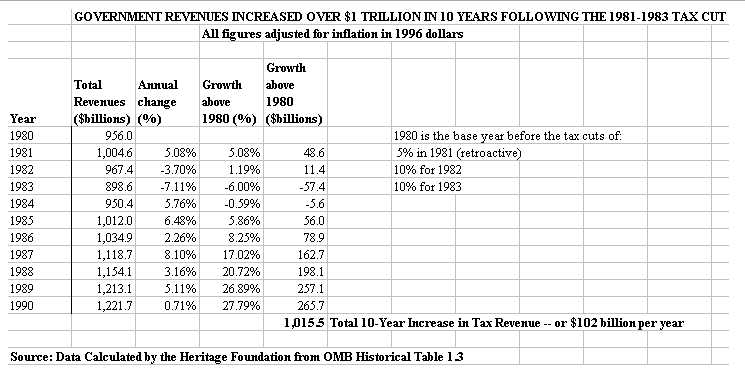
Did Reagan’s tax cuts decrease federal revenues? Hardly:

We find that 8 of the following 10 years there was a surplus of revenue from 1980, prior to the Reagan tax cuts. And, following the Tax Reform Act of 1986, there was a MASSIVE INCREASE of revenue.

So Reagan’s tax cuts increased revenue. But who paid the increased tax revenue? The poor? Opponents of the Reagan tax cuts argued that his policy was a giveaway to the rich (ever heard that one before?) because their tax payments would fall. But that was exactly wrong. In reality:

“The share of the income tax burden borne by the top 10 percent of taxpayers increased from 48.0 percent in 1981 to 57.2 percent in 1988. Meanwhile, the share of income taxes paid by the bottom 50 percent of taxpayers dropped from 7.5 percent in 1981 to 5.7 percent in 1988.”

So Ronald Reagan a) collected more total revenue, b) collected more revenue from the rich, while c) reducing revenue collected by the bottom half of taxpayers, and d) generated an economic powerhouse that lasted – with only minor hiccups – for nearly three decades. Pretty good achievement considering that his predecessor was forced to describe his own economy as a “malaise,” suffering due to a “crisis of confidence.” Pretty good considering that President Jimmy Carter responded to a reporter’s question as to what he would do about the problem of inflation by answering, “It would be misleading for me to tell any of you that there is a solution to it.”

Reagan whipped inflation. Just as he whipped that malaise and that crisis of confidence.
 
For the record, President George Bush’s 2003 tax cuts:

raised federal tax receipts by $785 billion, the largest four-year revenue increase in U.S. history. In fiscal 2007, which ended last month, the government took in 6.7% more tax revenues than in 2006.

These increases in tax revenue have substantially reduced the federal budget deficits. In 2004 the deficit was $413 billion, or 3.5% of gross domestic product. It narrowed to $318 billion in 2005, $248 billion in 2006 and $163 billion in 2007. That last figure is just 1.2% of GDP, which is half of the average of the past 50 years.

Lower tax rates have be so successful in spurring growth that the percentage of federal income taxes paid by the very wealthy has increased. According to the Treasury Department, the top 1% of income tax filers paid just 19% of income taxes in 1980 (when the top tax rate was 70%), and 36% in 2003, the year the Bush tax cuts took effect (when the top rate became 35%). The top 5% of income taxpayers went from 37% of taxes paid to 56%, and the top 10% from 49% to 68% of taxes paid. And the amount of taxes paid by those earning more than $1 million a year rose to $236 billion in 2005 from $132 billion in 2003, a 78% increase.

https://startthinkingright.wordpres...revenues-they-have-always-increased-revenues/
 
what the hell are you talking about? You comments shows you really don't understand this subject at all. When economists and commentators speak of tax cuts... we speak about tax rates... being lowered

Let me give you a primer.

after the rates were cut but melon, kennedy, reagan and bush, revenues went up to new highs within about 2 years.

consequently the only way to say they did not pay for themselves is to use hypothetical rates of growth and non reality based models.

Since I have shown you the revenue increases with links to the govt numbers in the past. this time I will give you a link to a website which adds some commentary. .
Admittedly, my earlier "explanation" was rather inelegant, to say the least. I'm not very suited to multi-tasking, and responding to your nonsense is rarely a priority for me. So, my bad. But the facts speak for themselves.

You may not like Greenspan. I know I don't much care for the way he handled the Fed. But for all our misgivings about him, he had the data. And while his judgment may be in question, the incontrovertible math speaks for itself and he said so. When he was asked if tax cuts pay for themselves, he said, "They do not." He didn't equivocate. He didn't preface his response by saying it was his opinion. He succinctly stated fact.

Don't like the facts? Take it up with him. And the CBO.

Former Minnesota Gov. Tim Pawlenty, a candidate for the Republican presidential nomination, supports a balanced budget amendment to the Constitution but also wants an $8 trillion tax cut. He rationalizes this contradiction by asserting that his tax cut will not actually lose any revenue. As Pawlenty told Slate reporter Dave Weigel on June 13:

“When Ronald Reagan cut taxes in a significant way, revenues actually increased by almost 100 percent during his eight years as president. So this idea that significant, big tax cuts necessarily result in lower revenues – history does not [bear] that out.”

In point of fact, this assertion is completely untrue. Federal revenues were $599.3 billion in fiscal year 1981 and were $991.1 billion in fiscal year 1989. That’s an increase of just 65 percent. But of course a lot of that represented inflation. If 1981 revenues had only risen by the rate of inflation, they would have been $798 billion by 1989. Thus the real revenue increase was just 24 percent. However, the population also grew. Looking at real revenues per capita, we see that they rose from $3,470 in 1981 to $4,006 in 1989, an increase of just 15 percent. Finally, it is important to remember that Ronald Reagan raised taxes 11 times,
increasing revenues by $133 billion per year as of 1988 – about a third of the nominal revenue increase during Reagan’s presidency.

The fact is that the only metric that really matters is revenues as a share of the gross domestic product. By this measure, total federal revenues fell from 19.6 percent of GDP in 1981 to 18.4 percent of GDP by 1989. This suggests that revenues were $66 billion lower in 1989 as a result of Reagan’s policies.

This is not surprising given that no one in the Reagan administration ever claimed that his 1981 tax cut would pay for itself or that it did. Reagan economists Bill Niskanen and Martin Anderson have written extensively on this oft-repeated myth. Conservative economist Lawrence Lindsey made a thorough effort to calculate the feedback effect in his 1990 book, The Growth Experiment. He concluded that the behavioral and macroeconomic effects of the 1981 tax cut, resulting from both supply-side and demand-side effects, recouped about a third of the static revenue loss.

Republicans also assert that the tax cuts of the George W. Bush years paid for themselves. On July 13, 2010, Senate Minority Leader
Mitch McConnell said that there was no net revenue loss from any of the Bush tax cuts, in defense of an earlier comment by Senator John Kyl that all spending increases must be offset so as not to increase the deficit, but tax cuts need never be offset. Said McConnell:

“There's no evidence whatsoever that the Bush tax cuts actually diminished revenue. They increased revenue, because of the vibrancy of these tax cuts in the economy. So I think what Senator Kyl was expressing was the view of virtually every Republican on that subject.”

This is a view not shared by economists who worked for Bush. For example, Alan Viard, senior economist at the Council of Economic Advisers during Bush’s first term, told the
Washington Post in 2006, “Federal revenue is lower today than it would have been without the tax cuts. There’s really no dispute among economists about that.” Robert Carroll, deputy assistant secretary for tax analysis at the U.S. Treasury Department during Bush’s second term, also told the Post, “As a matter of principle, we do not think tax cuts pay for themselves.” On September 28, 2006, Stanford economist Edward Lazear, chairman of the CEA in Bush’s second term, testified before the Senate Budget Committee:

“Will the tax cuts pay for themselves? As a general rule, we do not think tax cuts pay for themselves. Certainly, the data…do not support this claim. Tax revenues in 2006 appear to have recovered to the level seen at this point in previous business cycles, but this does not make up for the lost revenue during 2003, 2004, and 2005. The tax cuts were a positive step and have contributed to the enhanced economic growth, additional jobs, higher real disposable income, and the low unemployment rates that we currently see today.”

The truth is that no serious Republican economist has ever said that a tax rate reduction would recoup more than about a third of the static revenue loss. The following studies represent their generally accepted view.


  • A 2005 Congressional Budget Office study during the time that Republican economist Doug Holtz-Eakin was director concluded that a 10 percent cut in federal income tax rates would recoup at most 28 percent of the static revenue loss over 10 years. And this estimate assumes that taxpayers have unlimited foresight and know that taxes will be raised after 10 years to stabilize the debt/GDP ratio. Without foresight and no compensating tax increases or spending cuts, leading to an increase in the debt, feedback would be negative; i.e., causing the actual revenue loss to be larger than the static revenue loss.
  • In a 2006 article published in the Journal of Public Economics, Harvard economist Greg Mankiw, who chaired the CEA during Bush’s first term, estimated the long-run revenue feedback from a cut in taxes on capital at 32.4 percent and 14.7 percent for a cut in labor taxes.
  • A 2006 analysis of extending the 2001 and 2003 Bush tax cuts by the Republican-leaning Heritage Foundation estimated that only 30 percent of the gross revenue loss would be recouped through behavioral effects and macroeconomic stimulus.


For the record, the CBO recently
concluded that the Bush tax cuts reduced federal revenues $2.8 trillion between 2002 and 2011.

In short, there is no evidence whatsoever supporting Gov. Pawlenty’s view of the Reagan tax cuts or Sen. McConnell’s view of the Bush tax cuts. They didn’t pay for themselves and there is no reason to think that further tax cuts will, either. Republican economist Alan Greenspan confirmed this fact last year on “Meet the Press.” Asked whether he thought that tax cuts pay for themselves, as Republican leaders had said,
Greenspan replied, simply, “They do not.”

http://www.thefiscaltimes.com/Columns/2011/06/17/No-Gov-Pawlenty-Tax-Cuts-Dont-Pay-for-Themselves
 
Last edited:
1. I will start with the sock puppet covertiblity.

Your data shows exactly what we want to happen happens after tax rates are cut to stimulate the economy. Economic expansion as measured by GDP grows... The growth in the economy causes tax revenues to go up.

So we have the best of both worlds for a lefty and an establishment righty. Tax revenues going up and and expanding economy following tax cuts.

Thanks for playing covert.


Now to respond to the bullshit that freddie put out.

Fact from your article...

"Federal revenues were $599.3 billion in fiscal year 1981 and were $991.1 billion in fiscal year 1989. "

So we see revenues almost doubled under Reagan. That is a fact.
Lefist bullshit... to hide those facts.

1. normalize the data as a percent of GDP.
2. hide the increase by using inflation rates
3. use models to create the fake reality of what revenues could have been per certain growth rates.

2. By the way your team does the same thing with the Bush tax cuts.

These are the facts...

Federal govt revenues rose from $1.782 trillion in 2003 to $2.568 trillion in 2007 (using fiscal years). That’s a 44 percent increase.
 
1. I will start with the sock puppet covertiblity.

Your data shows exactly what we want to happen happens after tax rates are cut to stimulate the economy. Economic expansion as measured by GDP grows... The growth in the economy causes tax revenues to go up.

So we have the best of both worlds for a lefty and an establishment righty. Tax revenues going up and and expanding economy following tax cuts.

Thanks for playing covert.

You're just mad because you don't understand normalization (and you still don't understand what the chart says).

Just to add one more thing, Art Laffer was on CNBC a few years ago and even he stated that tax cuts do not increase revenues. (To further add, it is implied that tax rates are too low for tax cuts to increase revenues. We're not referring to the pre-JFK years).
 
Last edited:
You're just mad because you don't understand normalization (and you still don't understand what the chart says).

Just to add one more thing, Art Laffer was on CNBC a few years ago and even he stated that tax cuts do not increase revenues. (To further add, it is implied that tax rates are too low for tax cuts to increase revenues. We're not referring to the pre-JFK years).
who cares, tax cuts increase revenue to the person paying them. Corp taxes should be eliminated. Taxes are not too high, but the regulation associated with them is too consuming. You guys are arguing about how to keep the government healthy. My side is more concerned with the economy.
 
Back
Top