
You are using an out of date browser. It may not display this or other websites correctly.
You should upgrade or use an alternative browser.
You should upgrade or use an alternative browser.
Best Quote..
- Thread starter mgrund
- Start date

Interestingly, family wealth has a powerful affect on which sports young people get to play and practice, and have a shot at getting good enough for the major leagues. Basketball is relatively inexpensive; hockey and swimming, relatively expensive. The wealthier your parents, the better opportunities you have to demonstrate your gifts, if you have any, and ultimately play sports with high overhead.Quote from bigarrow:
And tall people have more opportunities in basketball.
Being given money only means that you might have a trust fund, or a better car, it does not mean you will perform better at any profession. There isn't any field I can think of where your salary or competance is determined by your daddy's money. Have you ever asked your doctor if he came from a wealthy family? I would maintain that most of the time trust fund kids are not highly motivated to work hard.
It's hard to get data because we cannot seperate out the causes, but we do have an example of an entire non-white cohort that was highly upwardly mobile. The asians basically started at 0 and were a target of discrimination. They now have higher household incomes than whites, so much for being white as the lottery winner. Proof that your parents income is not your statisical economic destiny in america.
Ricter, I know your religion is underpinned by the idea static economic classes but try looking at the world around you without bias. Just why the hell would tens of millions of mexicans break into this place only to be stuck as chicken processors? Asians come here with nothing for the opportunity you say does not exist, and they end up with more income than whites. How could that be in a racist, static class society?
Interesting stuff about asians, in contrast to blacks:
http://www.pewsocialtrends.org/2012/06/19/the-rise-of-asian-americans/
Polar opposite blacks in the kids and marriage thing, and I'll be damned, they value hard work instead of affirmative action as a way to get ahead. Sure seems to be working doesn't it?
They do not waste time dwelling on racism, probably because they recognize that asians are racist themselves. Some of them actually view it as an economic advantage, and they are probably right.
Here's probably the most interesting item
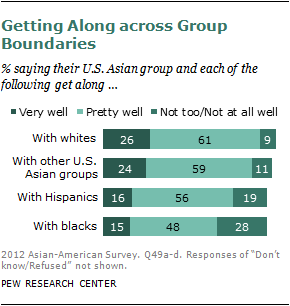
It seems they have a problem with blacks as well, and they say they get along better with whites than even other asians. When enough different people have a problem with you, when is it that you finally look in the mirror instead of blaming them?
It's hard to get data because we cannot seperate out the causes, but we do have an example of an entire non-white cohort that was highly upwardly mobile. The asians basically started at 0 and were a target of discrimination. They now have higher household incomes than whites, so much for being white as the lottery winner. Proof that your parents income is not your statisical economic destiny in america.
Ricter, I know your religion is underpinned by the idea static economic classes but try looking at the world around you without bias. Just why the hell would tens of millions of mexicans break into this place only to be stuck as chicken processors? Asians come here with nothing for the opportunity you say does not exist, and they end up with more income than whites. How could that be in a racist, static class society?
Interesting stuff about asians, in contrast to blacks:
http://www.pewsocialtrends.org/2012/06/19/the-rise-of-asian-americans/
The Rise of Asian Americans
....But despite often sizable subgroup differences, Asian Americans are distinctive as a whole, especially when compared with all U.S. adults, whom they exceed not just in the share with a college degree (49% vs. 28%), but also in median annual household income ($66,000 versus $49,800) and median household wealth ($83,500 vs. $68,529).
They are noteworthy in other ways, too. According to the Pew Research Center survey of a nationally representative sample of 3,511 Asian Americans, conducted by telephone from Jan. 3 to March 27, 2012, in English and seven Asian languages, they are more satisfied than the general public with their lives overall (82% vs. 75%), their personal finances (51% vs. 35%) and the general direction of the country (43% vs. 21%).
They also stand out for their strong emphasis on family. More than half (54%) say that having a successful marriage is one of the most important things in life; just 34% of all American adults agree. Two-thirds of Asian-American adults (67%) say that being a good parent is one of the most important things in life; just 50% of all adults agree.
Their living arrangements align with these values. They are more likely than all American adults to be married (59% vs. 51%); their newborns are less likely than all U.S. newborns to have an unmarried mother (16% vs. 41%); and their children are more likely than all U.S. children to be raised in a household with two married parents (80% vs. 63%).
Polar opposite blacks in the kids and marriage thing, and I'll be damned, they value hard work instead of affirmative action as a way to get ahead. Sure seems to be working doesn't it?
Asian Americans have a pervasive belief in the rewards of hard work. Nearly seven-in-ten (69%) say people can get ahead if they are willing to work hard, a view shared by a somewhat smaller share of the American public as a whole (58%).
They do not waste time dwelling on racism, probably because they recognize that asians are racist themselves. Some of them actually view it as an economic advantage, and they are probably right.
For the most part, todayâs Asian Americans do not feel the sting of racial discrimination or the burden of culturally imposed âothernessâ that was so much a part of the experience of their predecessors who came in the 19th and early 20th centuries.
About one-in-five Asian Americans say they have personally been treated unfairly in the past year because they are Asian, and one-in-ten say they have been called an offensive name. Older adults are less likely than young and middle-aged adults to report negative personal experience with bias.
Compared with the nationâs two largest minority groupsâHispanics and blacksâAsian Americans appear to be less inclined to view discrimination against their group as a major problem. Just 13% of Asian Americans say it is, while about half (48%) say it is a minor problem, and a third (35%) say it is not a problem.9
About six-in-ten say that being Asian American makes no difference when it comes to getting a job or gaining admission to college. Of those who do say it makes a difference, a slightly higher share say that members of their group are helped rather than hurt by their race. Those with less education are more prone than those with more education to say that being an Asian American is an advantage.
Here's probably the most interesting item
It seems they have a problem with blacks as well, and they say they get along better with whites than even other asians. When enough different people have a problem with you, when is it that you finally look in the mirror instead of blaming them?
Quote from Mav88:
jem, do know how easy it is for a black person with even just average grades to get college paid for or get loans?
Exhibit A- Obama
There is really that few of them, some 40% of black males can't even graduate high school
While I think Obama's politics are dead ass wrong - I you wish to improve the standard of living for almost everyone.
I still respect the fact he is a smart guy who worked his way up to be President.
Quote from Ricter:
Argumentum ad populum, therefore irrelevant.
dude learn some logic, I asked a rhetorical question about race relations, I didn't make a conclusion.
It's good advice for anybody. When everyone has a problem with you, it's time to look in the mirror.
One survey of Durham, in North Carolina, found that 59% of Latinos believed few or almost no blacks were hard-working, and a similar proportion reckoned few or almost none could be trusted
http://www.economist.com/node/9587776
You do in fact make a conclusion, "it's time to look in the mirror." Your premise (there is another, unstated) is, "everyone is saying X". Argument ad populum.Quote from Mav88:
dude learn some logic, I asked a rhetorical question about race relations, I didn't make a conclusion.
It's good advice for anybody. When everyone has a problem with you, it's time to look in the mirror.
http://www.economist.com/node/9587776