Being both long and short at same time

I have been trading in a similar way as buy and sell at the same time. Best way to describe it is A B A movement.
You buy and sell at A . (Same size trades)
Market moves to B.
You close the one in profit at B and keep the one in loss open. (Note the profit figure in $ aside to monitor your overall profit / loss level)
You open 2 new positions at B, as buy and sell.
Market moves back to A.
The position that was in loss at B is now breaks even at A.
You can close all open positions to complete the sequence because overall you are in profit.
You took the profit from A to B as X $.
You have a minor loss from the spread of the 2 positions you opened at B.
Even if you subtract your spread loss from the 2 open positions at B, you will still be in profit.
Actually you do not even have to wait for the market to go back to A.
As soon as the market reverses at B and starts moving towards back to A, you will be in profit.
Lets say you cashed in $100 at B. The one in loss was -$105 at B. As you move back from B to A just a bit, all open positions in loss is now -$85 , including the spread loss of the 2 new position you opened at B. You can close all open positions to take $15 overall profit. $100 -$85=$15
If you believe the market will move to A and even pass that level, you will wait and get more than $100 profit until the beginning of next pull back.
What happens if market moves from B to C in same direction from A to B?
At C, you close the position in profit that you opened at B and open 2 new positions at C.
Now you add your profits from A toB and B to C.
When ever the market reverses at any level, be it C or D or E, after %23 reversal you will be in profit. Every time I open a new buy and sell position, i slightly increase the position size.
At A 0.1 lot, at B 0.2 lot at C 0.3 lots. etc.
That helps to recover and be in profit earlier at reversals. Use support and resistance levels to open new positions as potential reversal levels.
You can also use upper and lower bollinger bands to open new positions when the market is rangeing.

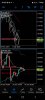
It would be nice to see a chart.
 
This line here:


There are no profits from B to C.
You bought 1 and sold 1 (the second position) at B, ie a box position.
If it goes to C from B, the profit you made (and took) from A to B>>> is lost.

I apoligize if I was not clear.
At every potential reversal level, for example at B, you cash in the position in profit (from A)and you open 2 new positions buy and sell.
When you come to C, one of the open positions from B (buy or sell) will be in profit.
You close that in profit and open a new pair(buy&sell) at C.
 
When you come to C, one of the open positions from B (buy or sell) will be in profit.
You close that in profit and open a new pair(buy&sell) at C.
But the other open position will be at a loss. You're boxed.
Opening another new boxed position does nothing.

Maybe I'm missing something in your description, but do know this, there are no fail-safe tricks trading stocks. Zero.

But try it. Paper trade a stock in this thread and we''ll see if it works. Use one of the fang stocks, they have enough movement from day to day.
And g/l, at least you're trying. :thumbsup:
 
I apoligize if I was not clear.
At every potential reversal level, for example at B, you cash in the position in profit (from A)and you open 2 new positions buy and sell.
When you come to C, one of the open positions from B (buy or sell) will be in profit.
You close that in profit and open a new pair(buy&sell) at C.
There is no magical, undiscovered, fixed formula for market riches. Believe me, it would have been discovered already and exploited very secretly.

All you have is understanding and timing. And many...many, many, people fail terribly here. But convince themselves they are special, and talented and genius and different from the rest of the zombie, sheep, herd out there trying to extract money from the market.
 
It would be nice to see a chart.
There is no magical, undiscovered, fixed formula for market riches. Believe me, it would have been discovered already and exploited very secretly.

All you have is understanding and timing. And many...many, many, people fail terribly here. But convince themselves they are special, and talented and genius and different from the rest of the zombie, sheep, herd out there trying to extract money
There is no magical, undiscovered, fixed formula for market riches. Believe me, it would have been discovered already and exploited very secretly.

All you have is understanding and timing. And many...many, many, people fail terribly here. But convince themselves they are special, and talented and genius and different from the rest of the zombie, sheep, herd out there trying to extract money from the market.

If there is anyone truely want to understand and try the modified grid hedging, I will be glad to explain the details. I have been using this for 18 months. We can exchange ideas to improve the system.
 

Attachments

  • Screenshot_20220624-200505_MetaTrader 5.jpg
    Screenshot_20220624-200505_MetaTrader 5.jpg
    696.5 KB · Views: 25
In below podcast (around minute 22), the guy describes how he has two separate accounts to be able to be both long and short at the same time. Is this something that you are not supposed to do but individual FCMs don't have responsibility to check?

What's the rationale for this kind of set up? This must work great in a range and the opposite side protects you if the range is violently broken in either direction?


You do not need 2 accounts to be long-short at the same time. That is a quite naive view.

It can, and should, be emulated by software.

One possible advantage of that is as follows.

Assume ideally you have 2 different strategies both with similar performances.
Imagine that the maximum exposure of the first strategy is 2X contracts.

If instead of playing strategy 1 with a max of 2X contracts, you play instead independently with both strategies, each with a max of X contracts, your average exposure will be lower.

This is due to the fact that the max exposure of the 2 strategies (max X contracts each) is at any time always less or equal to the exposure of a single strategy (max 2X contracts), because, at certain times, they will (partially) offset each other, but still, the overall PnL result is the algebraical sum of the 2 strategies (the 2 "layers", as I call them).

For the final results (PnL), it does not matter at all if they are on the same account or on two different accounts. It does matter for margins. So, if the approach is used, better on a unique account (unless there are different reasons for physical separation).
 
Last edited:
Isn't going both long and short like a synthetic stock (at least in options)? I do that sometimes if I'm pretty certain on direction (buy a call and sell a put or vice versa). It's much cheaper than buying or shorting the stock. I didn't watch the video, so I may be missing something.
 
Very late to the party, but this "technique" is exactly what I do.
With a bit more of bells and whistles, obviously.

For USA markets where your accounts will be offset on the same symbol, you can use highly correlated symbols that will behave like a single one, for example forex futures pairs tied to the dollar. There's always a way to bypass the rule.
 
Back
Top