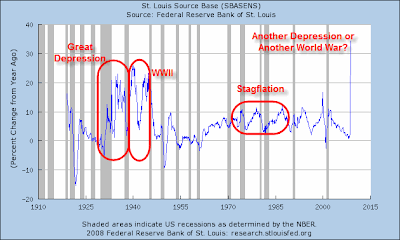
Makloda, i think you are most likely wrong about future inflation. While i don't think we will have hyperinflation so long as US bonds do not lose their credit rating, and the dollar remains the reserve currency, i am confident that we will have fairly high inflation for quite some time as we come out of the current recession. We already, in fact, have experienced high inflation in food in the past 18 months, and consumer commodity prices have remained near their highs despite falling producer prices (eventually we should see some of the latter translate to falling consumer prices.)
You brought up the Japanese situation. I would argue that the incentives favoring and opposing inflation in the US and Japan are quite different -- Japan is a nation of hoarders and savers, whereas the US has been a nation of borrowers and profligate spenders. (i believe the consumer savings rate actually went negative for a bit!.) And too, the Yen is not the world's reserve currency, so unfortunately for the Japanese, they are not in as favorable a position as the US is to get away with monetizing their debt.
As you know, when deficits occur it means the rate of spending exceeds the rate of income, and borrowing to pay current bills results. There are classic ways of dealing with this: 1. increased productivity. 2. Decreased spending, i.e., higher savings rate. 3. increased tax revenue. 4. Selling off of assets.
There will be efforts made toward applying all four of these remedies. However #1 is the most difficult to achieve and is a long term solution, #2 is politically very difficult -- just look at the opposition that Gates has right now, for example, #3 is the easiest by far to achieve, but increased direct taxation is political suicide, so the increase in taxation will be indirect via inflation. #4 will come into play to a certain extent, and we will see an increased rate of acquisition of assets by foreign interests.
There is in the US a tremendous incentive to inflate both from the viewpoints of Government and the private sector, since both sectors have large debt. The debts are so large that it would be impossible to repay them directly in dollars with constant buying power without a huge decrease in the standard of living, so other means of paying on these debts will be used.
By far the most politically attractive method of paying on the debt is to inflate it away, which economists call "monetizing the debt".
Because of the special position of the dollar, as the world's reserve currency, the US is in a very favorable position when it comes to monetizing. This will enable it, in all likelihood, to get away with cheating our creditors by monetizing. The world is awash in dollars! Consequently central banks everywhere prefer to see the dollar propped up. They do not want to see the dollar collapse, for very obvious reasons. And this is why it is critical for the dollar not to lose its status as the reserve currency, and at the same time why it probably won't lose that status. In the meantime, the Treasury can exploit the dollars special status via inflation, and again, they will very likely get away with it. So in the case of the US, it seems almost a foregone conclusion that we will eventually have quite high, though not hyper-, inflation. I think this is likely what Soros is smiling about when he says he "...knows exactly what the dollar will do, but can't tell [us]." He, of course, realizes that we will inflate.
Inflation is a subtle form of indirect taxation, and probably less than one person in ten understands the relationship between deficits and inflation. The typical citizen who cries for lower taxes does not understand that in a deficit environment lower taxes will almost certainly result in higher inflation. Regardless, in the end they will only have 5 dollars of purchasing power in their pocket where they previously had 10$.
Of course the Fed will gradually tighten once signs of recovery arrive, but they won't tighten enough to choke inflation off entirely because there is simply no incentive to do so. And deflation must be absolutely avoided, or else you will be returning to your creditors more buying power than you borrowed. That's not going to happen!
So yes, we will have, eventually, quite high inflation. You can count on it!