Basic Strategy to earn 10% yearly?

You can detect them perhaps by using 3rd party reports or statements made by the company that shows perhaps their positions, in/out, volume, then try to find patterns?
I think you have some distorted impression of how HFT works.
They are mainly doing "just" frontrunning by the sheer speed advantage they have; no other long term strategy or patterns but this.
 
https://volow.co/book/read/systematic-trading
Just a comparison / easier explanation is all i was asking, I hate when I get that answer, when you could of typed up a simple explanation for what it is, instead you type why I need to read more, sorry don't mean to sound rude.

I spend all my time to read to code better, I cant spend time I don't have to learn every detail about the markets too, that is impossible for a human. We cant do it all. That is why I am asking here from financial experts. I am good at one thing, traders are good at another.

Also the reason I think you cannot track every stock in real time is because python would break under such pressure. Python does really poor with async ops/threading, there is also no really good libraries for it as python was designed to be single threaded originally, there are some perhaps Gevent or QT, but everytime I used it I expressed great frustration and wondered why I am using python in the firstplace.

Hi JJ

These are basic and very important concepts which it is worth understanding in detail, not tiny details that only experts know.

I'm donating my time for free in answering your queries. This is a pretty good deal for you; I used to get paid quite a lot of money and you're getting a 100% reduction on that cost. It's a very inefficient use of my time to answer queries about basic concepts which could be answered by doing some googling and doing some research and reading.

A more efficient use of my time is to answer questions which can't be easily answered in this way and which require some specialist skill and experience. Knowing what sharpe ratio and Kelly criteria are doesn't fall into this category.

GAT

PS You can get a free copy of my book for a limited period here https://volow.co/book/read/systematic-trading. Sharpe ratio is explained in chapter two, and Kelly in chapter nine.
 
Can you explain this: expected sharpe ratio of 0.5. If you run that at half Kelly (25% annualised vol). Even investopia has trouble explaining a sharpe ratio to me.
It's simple maths:
sharpe_ratio = CAGR / stddev(CAGR)
It should be > 1.0
An example for CAGR you can find at http://www.investopedia.com/terms/c/cagr.asp
And Sharpe Ratio at http://www.investopedia.com/terms/s/sharperatio.asp
There are many more sources on the net, just search here at ET or google for more info.
Nearly every book on systematic trading explains it. Don't you have any trading literature?
 
Last edited:
That is why I am asking here from financial experts. I am good at one thing, traders are good at another.
And the financial experts are telling you that you're simply naive about what you think you can accomplish. You've gotten a lot of great, realistic feedback here about the financial side of what you want to do, something you admit you know nothing about. In my humble opinion you're disregarding all of it because it isn't what you want to hear. You're really in trouble when you do find the person who feeds you the line you want to hear.
 
It's simple maths:
sharpe_ratio = CAGR / stddev(CAGR)
It should be > 1.0
An example for CAGR you can find at http://www.investopedia.com/terms/c/cagr.asp
And Sharpe Ratio at http://www.investopedia.com/terms/s/sharperatio.asp
There are many more sources on the net, just search here at ET or google for more info.
Nearly every book on systematic trading explains it. Don't you have any trading literature?


I see interesting I think I get it now. But this is something that cannot apply to short positions or shortterm trading?

For example I look into UWTI 3.95 Dec 31, 2015, 314.4 Dec 31, 2013, (314.4 / 3.95)*(1/2) = 39.79 = CAGR,
stddev(CAGR) = 219.5. So 0.18 Sharpie?

Sharpie is something you calculate after you exit your position, or before you get in?
 
Another daydreamer... ;-)
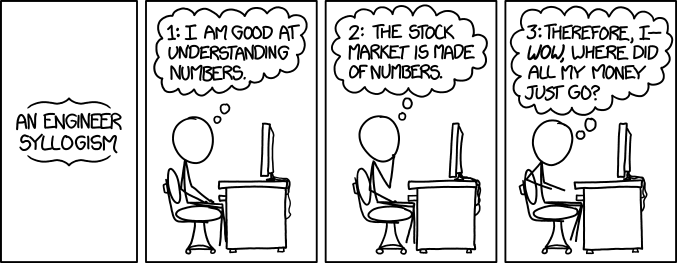
engineer_syllogism.png
 
I see interesting I think I get it now. But this is something that cannot apply to short positions or shortterm trading?

For example I look into UWTI 3.95 Dec 31, 2015, 314.4 Dec 31, 2013, (314.4 / 3.95)*(1/2) = 39.79 = CAGR,
stddev(CAGR) = 219.5. So 0.18 Sharpie?

Sharpie is something you calculate after you exit your position, or before you get in?

"Sharpie" ;-)
Oh. man, that all is so embarrassing... You should do a reality check and a fact check...
 
Back
Top