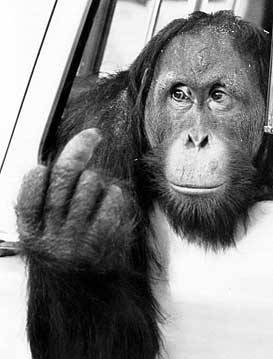
Dan the baboon sits in front of a computer screen. The letters BRRU pop up. With a quick and almost dismissive tap, the monkey signals it is not a word. Correct. Next comes, ITCS. Again, not a word. Finally KITE comes up.
He pauses and hits a green oval to show it is a word. In the space of just a few seconds, Dan has demonstrated a mastery of what some experts say is a form of pre-reading and walks away rewarded with a treat of dried wheat.
Dan is part of new research that shows baboons are able to pick up the first step in reading -- identifying recurring patterns and determining which four-letter combinations are words and which are just gobbledygook.
It's still a far cry from real reading. They don't understand what these words mean, and are just breaking them down into parts, said Grainger, a cognitive psychologist at the Aix-Marseille University in France.
This raises interesting questions about how the complex primate mind works without language or what we think of as language, Hopkins said. While we use language to solve problems in our heads, such as deciphering words, it seems that baboons use a "remarkably sophisticated" method to attack problems without language, he said.
Key to the success of the experiment was a change in the testing technique, the researchers said. The baboons weren't put in the computer stations and forced to take the test. Instead, they could choose when they wanted to work, going to one of the 10 computer booths at any time, even in the middle of the night.
The most ambitious baboons test 3,000 times a day; the laziest only 400.
This baboon just learned how to smoke ganja.
<img src="http://media1.break.com/dnet/media/2012/4/9/47f09649-0fdc-49c2-a181-356ec050f4a1.jpg">
He pauses and hits a green oval to show it is a word. In the space of just a few seconds, Dan has demonstrated a mastery of what some experts say is a form of pre-reading and walks away rewarded with a treat of dried wheat.
Dan is part of new research that shows baboons are able to pick up the first step in reading -- identifying recurring patterns and determining which four-letter combinations are words and which are just gobbledygook.
It's still a far cry from real reading. They don't understand what these words mean, and are just breaking them down into parts, said Grainger, a cognitive psychologist at the Aix-Marseille University in France.
This raises interesting questions about how the complex primate mind works without language or what we think of as language, Hopkins said. While we use language to solve problems in our heads, such as deciphering words, it seems that baboons use a "remarkably sophisticated" method to attack problems without language, he said.
Key to the success of the experiment was a change in the testing technique, the researchers said. The baboons weren't put in the computer stations and forced to take the test. Instead, they could choose when they wanted to work, going to one of the 10 computer booths at any time, even in the middle of the night.
The most ambitious baboons test 3,000 times a day; the laziest only 400.
This baboon just learned how to smoke ganja.
<img src="http://media1.break.com/dnet/media/2012/4/9/47f09649-0fdc-49c2-a181-356ec050f4a1.jpg">