Maybe your Government should consider inviting Singapore's Head of their Housing Board to help out? I think they are a little more credible and practical than those Chinese property developers.analysis
If housing was considered a human right, would it fix our housing crisis?
By business reporter Gareth Hutchens Posted 50 minutes ago
https://www.abc.net.au/news/2023-11...man-right-or-a-pure-financial-asset/103089296

Should housing be considered a fundamental human right?(ABC News: Arianna Levy)
What should we do about our housing crisis?
Here's how policymakers from the past thought about housing and citizenship and economic rights:
"We consider that a dwelling of good standard and equipment is not only the need but the right of every citizen – whether the dwelling is to be rented or purchased, no tenant or purchaser should be exploited for excessive profit."
That was written in 1944 by the Commonwealth Housing Commission.
The Commission had been given the task, by the wartime Labor government, of figuring out how to fix Australia's acute housing shortage and provide adequate housing for everyone in the aftermath of World War II.
It estimated it would require, by the end of 1955, the erection of at least 700,000 dwellings, and it recommended a major building program.
It said the program may need an extra 35,000 to 45,000 tradesmen, and that immigration policy should encourage more building labour to come to Australia.
It was scornful of the way private landlords had historically treated renters in this country, and said housing was a right and should stop being a "field of investment" that yielded high profits for a minority of landowners.
It recommended a large amount of government-financed housing be built for sale and rent for low income households, with weekly rents being no more than one-sixth of a family's income.
It said we had to get Australians into homes, and those homes should be affordable and adequate — not sites of exploitation for profit.
Does any of that feel familiar?
Well, last week the NSW Housing Minister, Rose Jackson, said we'll have to treat housing as a "fundamental human right" if we're to fix our current housing crisis.
It's a time capsule that reflects the aspirations of housing reformers of that period in history.
While many of its recommendations were ignored, it provided the background to the first Commonwealth and State Housing Agreement (CSHA) signed in 1945, in which the federal government agreed to provide funding for public housing, and state governments agreed to build and operate that public housing to provide security of tenure to Australians who couldn't afford to own a home.
Under that agreement, the federal government hoped to see between 20,000 and 30,000 low-income dwellings built in its first year, and later 70,000 a year until the post-war housing shortage was overcome and all substandard dwellings were replaced around the country.
It estimated it would take about 10 years.
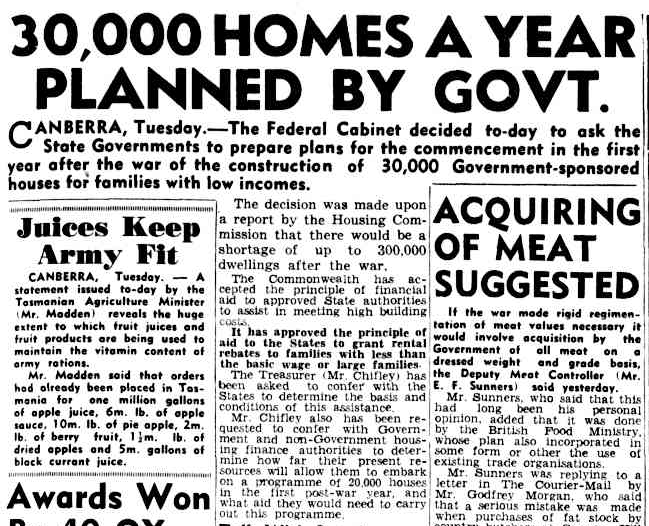
After the Commonwealth Housing Commission published its first interim report, the Curtin Labor Government announced its plans for a home-building program after the war.(Courier Mail, 8 December, 1943, page 3)
That first CSHA agreement was followed by renewed housing agreements in 1956, 1961, 1966, 1973, 1978, 1981, 1984 and beyond, as the housing needs of Australians, and as Commonwealth-State relations, evolved over time.
But the second agreement, in 1956, was significantly amended by the Menzies Coalition government to promote private home ownership over public rental housing.
It encouraged state governments to sell houses that had been built for rent under the original 1945 CSHA, and it diverted some federal funding away from public housing and rental assistance schemes to help middle income earners buy a home.
At the same time, there was strong growth around Australia in owner-building, made possible by the large number of prematurely subdivided blocks and vacant allotments that were sitting idle in major cities from the pre-war era.
As those dynamics combined, it saw the overall level of home ownership lift from 53.4 per cent of households in 1947 to 71.4 per cent by 1966.
A huge amount of direct government intervention had helped to create the "Australian dream" of widespread home ownership.
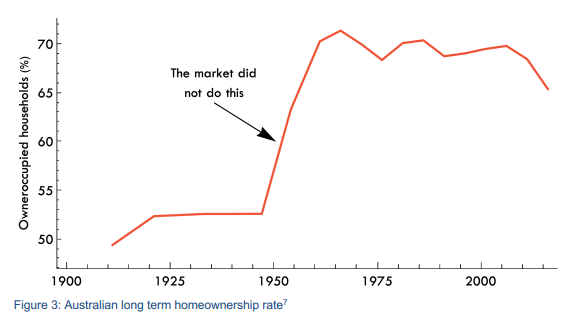
The "Australian dream" of home ownership was deliberately created.(Source: Dr Cameron Murray, submission to the House of Representatives Standing Committee on Tax and Revenue’s inquiry into Housing Affordability and Supply, September 2021)
But as the decades rolled by, the motivating spirit of that first Housing Commission report was left in the past.
As more public housing was sold off in the 1970s, 80s, and 90s, public housing waiting lists grew longer, and low income families were increasingly pushed back into private rental markets to sink or swim, with homelessness rising.
According to the late Professor Patrick Troy, by the mid-1990s Australian governments were recreating the social conditions that had originally led to the demands for a national public housing program in the 1940s.
But fast forward to today, and some policymakers are now reviving some of the old wisdom to combat our current housing problems.
"Housing should not be seen as a financial asset, it should be seen as a fundamental human right," Ms Jackson said.
"Surely we need our tax system to enable opportunity for everyone to have secure access to one home before incentivising a minority to have many," former NSW Planning Minister, Rob Stokes, said at the at the same event.
It's really interesting to see representatives of rival political parties sharing such similar opinions.
Has there been a genuine shift in the political wind?
While we think about that, the old Housing Commission report from 79 years ago has a few more concerns worth considering.
The report's authors were very conscious of the damage that can occur to society when property prices rise too quickly, saying rapidly rising prices place an "undue burden" on younger generations.
They said for much of modern Australia's history, interest rates and initial deposits demanded had prevented many low-income earners from purchasing a home, leaving them to fend for themselves in private rental markets where speculative landlords expected a high yield on their investments, which had obvious consequences for families trapped in the unforgiving rental cycle.
And they said the private sector had repeatedly failed to build adequate housing for low-income groups in Australia, suggesting that governments should accept responsibility for doing so.
In short, they warned if you treated housing like a financial asset, rather than a right, you end up with serious social problems.
"The Commission considers that the housing of the people of the Commonwealth adequately, soundly, hygienically, and effectively, each according to his social and economic life is a national need, and, accordingly, should cease to be a field of investment yielding high profits," they concluded.

You are using an out of date browser. It may not display this or other websites correctly.
You should upgrade or use an alternative browser.
You should upgrade or use an alternative browser.
Australia’s property boom making the nation poorer
- Thread starter themickey
- Start date

100% !Maybe your Government should consider inviting Singapore's Head of their Housing Board to help out? I think they are a little more credible and practical than those Chinese property developers.
Mao was right in the way he treated the landlords.
Its obviously a troll but for those who don't know,couple of million murders.
Mass killings of landlords[edit]
Destruction of the Chinese landlord class (1949–1953)
Part of Early Mao era of China

A farmer confronting a landlord, 1946
Location China
Date 1946–1953
Attack type
Massacre, classicide
Deaths 200,000 – 5,000,000
Injured 1.5[71]–6[72] up to 12.5[73] million sent to Laogai camps
Victims Landlords, rich peasants
Perpetrators Chinese Communist Party and radicalized peasants
Motive Maoism, economic inequality, class struggle
Victims were targeted on the basis of their social class rather than their ethnicity; the neologism classicide is used to describe the killings.[74] Class-motivated mass murder continued almost throughout the 30 years of social and economic transformation in Maoist China, and by the end of the reforms, the landlord class had largely been eliminated from Mainland China or it had fled to Taiwan.[75]
Mao's 1927 "Report on an Investigation of the Peasant Movement in Hunan" addressed CCP members who were concerned with violence by the peasants against landlords, arguing that these concerns were a tool for continuing the oppression of the peasants. In this context, Mao coined his famous comment that "revolution is not a dinner party." Mao wrote in response to objections to violence:[76]
It is fine. It is not "terrible" at all. It is anything but "terrible." ... "It's terrible!" is obviously a theory for combatting the rise of the peasants in the interests of the landlords; it is obviously a theory of the landlord class for preserving the old feudal order and obstructing the establishment of the new democratic order; it is obviously a counterrevolutionary theory.
Politicians shed crocodile tears for Australians struggling to get onto the property ladder, but everytime the housing ponzi scheme slows down the government increases immigration or announces some new home buyer bonus.
I think guys like @themickey with 11/12 investment properties are not helping with the housing shortage.
I think guys like @themickey with 11/12 investment properties are not helping with the housing shortage.
Hehehehe, how do you that?
Just a guessHehehehe, how do you that?

On the serious note can ASX shares be day traded on 30M or less time frames ?
There is no time limit for trading a position, can be 1 second if you wish.Just a guess
On the serious note can ASX shares be day traded on 30M or less time frames ?
But there is a limit on value, I was awarded some options once and I couldn't sell them as they were below a marketable parcel, their web site says $500 minimum for an initial purchase and then vaguely adds you can top up with lesser amounts.
Looks like they don't wish to transact below $500, but there's no time limits.

Majority of the time I'd say no. Better off trading the spi if you want to day trade anything on the ASX.Just a guess
On the serious note can ASX shares be day traded on 30M or less time frames ?
Sorry, I misinterpreted the query, daytrading on asx less than 30minutes, tf, I dont know.Just a guess
On the serious note can ASX shares be day traded on 30M or less time frames ?
Atm I'm trading penny stocks, but not day trading.
I couldn't day trade to save myself, except once I got lucky, I bought a penny stock which popped, like a blowoff top and in a couple of hours I bought and sold a quite large position.
But it was a fluke, just was in the right spot at the right time.
I normally trade Asian futures from around midday. Apart from SPI as getthatintoya mentioned there is nothing much to day trade in the mornings.