Opinion
Australia's election is a contest about character and competence
Six-week campaign has been uninspiring and at times unedifying
Michelle Grattan May 18, 2022 05:00 JST
https://asia.nikkei.com/Opinion/Australia-s-election-is-a-contest-about-character-and-competence
Scott Morrison waves during the campaign launch in Brisbane on May 15: Morrison made a late bid for momentum. © AAP/AP
Australians go to the ballot box on Saturday after a six-week election campaign dominated by economic issues and questions about the character of Prime Minister Scott Morrison and the competency of opposition leader Anthony Albanese.
The polls have pointed to a Labor win. But with the electoral map complicated and the coalition's surprise victory in 2019, commentators are hedging their predictions. On Tuesday night, a Resolve poll showed the race tightening.
In his formal campaign launch on Sunday, Morrison made a late bid for momentum, pledging to give first homebuyers access to a portion of their retirement savings to help with housing affordability. It is thought the best Morrison could hope for is a hung parliament, which would mean negotiating with a clutch of crossbench MPs.
If Labor wins, it will be Australia's first change of national government since 2013.
In foreign policy, government and opposition have broadly bipartisan policies, so changes in how Australia would deal with the world under Labor would be a matter of nuance rather than substance.
During the campaign, the government has tried to make national security a theme. But Labor exploited Morrison's apparent unpreparedness for the recently-announced
China-Solomons security agreement, although it is unlikely a Labor government would have been any better placed to ward it off.
The election has been uninspiring and at times unedifying, with scrapping in the weeds rather than any visionary policy debate.
Australia navigated the pandemic well on both the health and economic fronts. Its death rate was low, although that ticked up this year after restrictions were lifted. The government dropped its traditional preoccupation with debt and deficit to adopt an expensive JobKeeper subsidy scheme that kept thousands of businesses and millions of workers afloat.
The Australian economy has bounced out of the COVID recession strongly. Gross domestic product growth was 4.2% in the year to December. Unemployment has gone down to 4%, almost a five-decade low, and is set to go lower. Job vacancies are at a record high. Labor shortages are frustrating businesses, with employers anxious to see migration, halted when the borders were closed, increase quickly.
Despite Morrison insisting he has a plan for the future, what's on offer are mostly piecemeal sweeteners. The government's weakest point is Morrison himself, who has become toxic to an extraordinary degree with many voters.
Trust in Morrison has dramatically worsened since the 2019 election, despite some improvement during the pandemic. He did himself immense harm when he went on holiday to Hawaii during the devastating 2019-20 bush fires and then, defending himself, said, "I don't hold a hose, mate."
Morrison's integrity has come under sustained attack, which has played into Labor's hands. French President Emmanuel Macron said Morrison lied to him over Australia's now-canceled contract for France to supply submarines. A Liberal state premier called Morrison, in a leaked text message, a horrible person; Barnaby Joyce, leader of the Nationals, the coalition's minority partner, described him as a liar in another leaked text message dating from 2021, when Joyce was on the backbench.
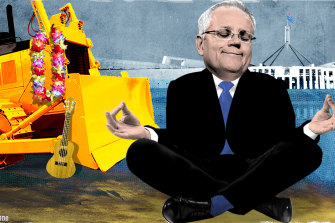
Last week Morrison admitted that he could be a "bit of a bulldozer" and promised to "empathize" a lot more if reelected. Polling suggests the coalition would be in a better position on Saturday if Treasurer Josh Frydenberg were leading.
As it is, Frydenberg and a number of moderate Liberals in traditionally safe seats are fighting for their political lives in the face of
challenges by teal candidates, so dubbed because they represent a mix of Liberal blue and environmental green.
These candidates, predominantly professional women, are campaigning primarily on climate change and the need for a federal integrity commission. The government has adopted zero net carbon emissions by 2050 but is a laggard on medium-term targets.
Thus the Liberals are battling on two fronts
- against Labor and against the teals. It is near impossible to predict how the teal challengers will fare: all could fall just short, or a handful could be elected.
A firebrand in his youth, Albanese is from Labor's left faction but is now a centrist. He served as Infrastructure Minister in the Labor governments of a decade ago and as leader of the House of Representatives, including during the last hung parliament from 2010 to 2013. He was very briefly deputy prime minister.
Anthony Albanese speaks during the campaign rally in Brisbane on May 15: Albanese is from Labor's left faction but is now a centrist. © Getty Images
He lacks charisma, and one problem going into this campaign was that many voters had little or no firm impressions of him. But in contrast to Bill Shorten, who led Labor to defeat in 2019, he is not disliked by voters.
During the campaign, Albanese contracted COVID, and his frontbenchers had to step up to fill the gap. This had its positive side because the Labor team has some impressive performers, including its very popular leader in the Senate, Penny Wong, Labor's foreign affairs spokeswoman.
For three years, Albanese has run a small target strategy, driven by Labor's 2019 experience when it offered a bold platform. He has continued this approach in the campaign, including adopting some of the government's policies.
Morrison paints an Albanese government as a risk to the economy and to national security. The government highlights that as a minister, Albanese did not hold an economic portfolio.
When Albanese embraced the idea of a rise of 5.1% in the minimum wage last week to match Australia's latest annual inflation rate, the government denounced him as irresponsible. But Albanese, running hard on cost of living issues, was able to turn this to his advantage with the argument that the lowest-paid should not be left behind.
After flying around the country for six weeks, whoever wins on Saturday will be back on a plane immediately to attend the Quad leaders summit in Tokyo on Tuesday. For Morrison, this would be routine.
For Albanese, who has said he would visit Indonesia early and attend the Pacific Islands Forum, it would be an important first test on the international stage.





 ionne Gain