
You are using an out of date browser. It may not display this or other websites correctly.
You should upgrade or use an alternative browser.
You should upgrade or use an alternative browser.
Atheists, agnostics most knowledgeable about religion, survey says
- Thread starter olias
- Start date
Quote from peilthetraveler:
I am going to open this question to everyone. What evidence did you weigh against God to make you believe God doesnt exist?
By the way, of course this takes us back to the burden on proof dilemma...
What evidence is there that god DOES exist? None, therefore I don't believe in god.
Simply saying something along the lines of "we don't know how or why the universe exists, therefore god exists" simply makes no sense.

Quote from Kassz007:
By the way, of course this takes us back to the burden on proof dilemma...
What evidence is there that god DOES exist? None, therefore I don't believe in god.
Simply saying something along the lines of "we don't know how or why the universe exists, therefore god exists" simply makes no sense.
Plenty of evidence that God exists. All of creation, everything you see, hear, smell, taste and touch is a testament to Gods existence.
A logical mind sees a painting and knows their must have been a painter. If the painting is not signed and you cant find the painter, do you say "the painter does not exist because their is no proof"? Isnt the painting a testament to the painter?
Now your turn. What proof is there that God DOESNT exist?
Quote from Kassz007:
This is it right here. If they did question their religion, they'd be shocked at what they find. Better to remain in ignorance, and not question all of the shit that makes absolutely no sense.
Same with Atheism, right? I mean if an atheist really thought about the big bang and how nothingness created everything (shit that makes absolutely no sense) they would be shocked at what they find. Better to remain in ignorance..
yoo darn tootin' dares a God
<object width="480" height="385"><param name="movie" value="http://www.youtube.com/v/hnbVqwV8aw4?fs=1&hl=en_US"></param><param name="allowFullScreen" value="true"></param><param name="allowscriptaccess" value="always"></param><embed src="http://www.youtube.com/v/hnbVqwV8aw4?fs=1&hl=en_US" type="application/x-shockwave-flash" allowscriptaccess="always" allowfullscreen="true" width="480" height="385"></embed></object>
HALLELUEHALEHEIM_EN!! Fer JEEEEZUS!
Quote from peilthetraveler:
Plenty of evidence that God exists. All of creation, everything you see, hear, smell, taste and touch is a testament to Gods existence.
A logical mind sees a painting and knows their must have been a painter. If the painting is not signed and you cant find the painter, do you say "the painter does not exist because their is no proof"? Isnt the painting a testament to the painter?
Now your turn. What proof is there that God DOESNT exist?
I'll sum up what you just said in this post:
"God exists because the Earth exists."
A six year old child would even know that this is not proof. Your analogy to a painting is not applicable, because we can watch the painter paint the painting, and therefore know the painting was created by the painter. We cannot watch "god" do anything at all.
Again, how do you prove something doesn't exist? You might as well be asking me to prove unicorns don't exist. How do you suggest I do this?
Quote from peilthetraveler:
Same with Atheism, right? I mean if an atheist really thought about the big bang and how nothingness created everything (shit that makes absolutely no sense) they would be shocked at what they find. Better to remain in ignorance..
The big bang theory is just that - a theory. I have researched the big bang theory to an adequate degree and would not consider myself to remain in ignorance, something of which I'm almost positive you have not. More still, if I am in ignorance, I certainly don't wish to remain in ignorance, as most religious believers do.
Just because YOU don't understand the big bang theory, doesn't mean it doesn't make sense. I suspect the only thing you have gathered from the big bang theory is that "something is created from nothing", and then stopped your learning right there. Hard to debate the uneducated.

Quote from Rearden Metal:
I think you know what comes next in this cliché dialogue. This is the part where someone asks you; "Ok, if everything that exists must have been created or designed, who created God?"
As the "great" Mr. Hawking's has already stated, there is no need for anything to be created. God can simply pop into existence out of nothing, for no reason at all. If that theory works for the universe in general, as Hawking's claims, then it works for God too. Round and round we go.

Quote from olias:
http://articles.latimes.com/2010/sep/28/nation/la-na-religion-survey-20100928
Atheists, agnostics most knowledgeable about religion, survey says
Report says nonbelievers know more, on average, about religion than most faithful. Jews and Mormons also score high on the U.S. Religious Knowledge Survey.
September 28, 2010|By Mitchell Landsberg, Los Angeles Times
If you want to know about God, you might want to talk to an atheist.
Heresy? Perhaps. But a survey that measured Americans' knowledge of religion found that atheists and agnostics knew more, on average, than followers of most major faiths. In fact, the gaps in knowledge among some of the faithful may give new meaning to the term "blind faith."
A majority of Protestants, for instance, couldn't identify Martin Luther as the driving force behind the Protestant Reformation, according to the survey, released Tuesday by the Pew Forum on Religion & Public Life. Four in 10 Catholics misunderstood the meaning of their church's central ritual, incorrectly saying that the bread and wine used in Holy Communion are intended to merely symbolize the body and blood of Christ, not actually become them.
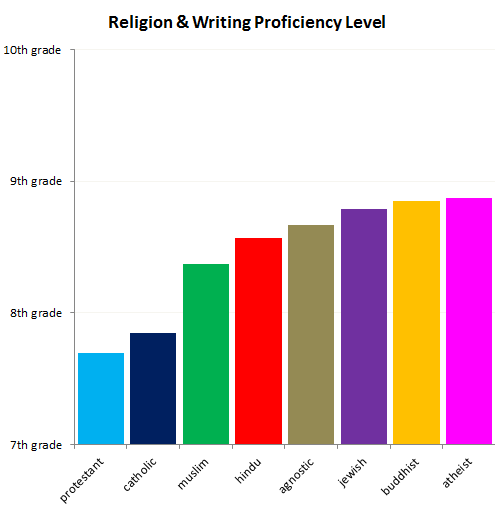
Atheists and agnostics â those who believe there is no God or who aren't sure â were more likely to answer the survey's questions correctly. Jews and Mormons ranked just below them in the survey's measurement of religious knowledge â so close as to be statistically tied.
So why would an atheist know more about religion than a Christian?
American atheists and agnostics tend to be people who grew up in a religious tradition and consciously gave it up, often after a great deal of reflection and study, said Alan Cooperman, associate director for research at the Pew Forum.
"These are people who thought a lot about religion," he said. "They're not indifferent. They care about it."
Atheists and agnostics also tend to be relatively well educated, and the survey found, not surprisingly, that the most knowledgeable people were also the best educated. However, it said that atheists and agnostics also outperformed believers who had a similar level of education.
The groups at the top of the U.S. Religious Knowledge Survey were followed, in order, by white evangelical Protestants, white Catholics, white mainline Protestants, people who were unaffiliated with any faith (but not atheist or agnostic), black Protestants and Latino Catholics.
Muslims, Hindus and Buddhists were included in the survey, but their numbers were too small to be broken out as statistically significant groups.
Stephen Prothero, a professor of religion at Boston University and author of "Religious Literacy: What Every American Needs to Know â And Doesn't," served as an advisor on the survey. "I think in general the survey confirms what I argued in the book, which is that we know almost nothing about our own religions and even less about the religions of other people," he said.
He said he found it significant that Mormons, who are not considered Christians by many fundamentalists, showed greater knowledge of the Bible than evangelical Christians.
The Rev. Adam Hamilton, a Methodist minister from Leawood, Kan., and the author of "When Christians Get it Wrong," said the survey's results may reflect a reluctance by many people to dig deeply into their own beliefs and especially into those of others.
"I think that what happens for many Christians is, they accept their particular faith, they accept it to be true and they stop examining it. Consequently, because it's already accepted to be true, they don't examine other people's faiths. ⦠That, I think, is not healthy for a person of any faith," he said.
The Pew survey was not without its bright spots for the devout. Eight in 10 people surveyed knew that Mother Teresa was Catholic. Seven in 10 knew that, according to the Bible, Moses led the exodus from Egypt and that Jesus was born in Bethlehem.
The question that elicited the most correct responses concerned whether public school teachers are allowed to lead their classes in prayer. Eighty-nine percent of the respondents correctly said no. However, 67% also said that such teachers are not permitted to read from the Bible as an example of literature, something the law clearly allows.
For comparison purposes, the survey also asked some questions about general knowledge, which yielded the scariest finding: 4% of Americans believe that Stephen King, not Herman Melville, wrote "Moby Dick."
mitchell.landsberg@latimes.com
This really doesn't surprise me all that much. It seems that a man who takes a pessimistic view of any topic usually winds up doing more research on the subject. He is the one who is trying to disprove what the majority accepts as truth. I think that more people who believe in God are going to scrutinize and research the findings of this article than atheists will.
It seems to be in our nature to want to disprove others more than to reinforce our own beliefs by questioning them. I agree with Peil when he discusses the hypothetico-deductive model and people not actually questioning the conclusions they come to. However, that is a two-way street.