
You are using an out of date browser. It may not display this or other websites correctly.
You should upgrade or use an alternative browser.
You should upgrade or use an alternative browser.
Are There Any Successful Option Buyers ?
- Thread starter Fundlord
- Start date
If the market rallies 10% and stay there, your ATM options on a percentage basis will usually be up more than 10% after the 6% cost. So, the whole idea is to manage your profits and risks? For example, if I then buy a collar to protect the gain and wait it out assume I want my profit to run later on?For example:
A 1Y call option costs 6%. If the market rallies 10% then you will underperform by 6%. If after that the stock market selloff 10% then the option will outperform the market by 4% netting an underperformance of 2% with the index returning zero.
However, if the market rallies 20% and then sells off 20%, the option will return a net of 8% (14% and then -6%) while the market returns 0%.
If the market rallies 10% and stay there, your ATM options on a percentage basis will usually be up more than 10% after the 6% cost. So, the whole idea is to manage your profits and risks? For example, if I then buy a collar to protect the gain and wait it out assume I want my profit to run later on?
You shouldn't compare %age returns of the option to the underlying. You need to compare the option notional (stockprice*option contracts) to the underlying notional (stockprice*shares) for it to be an apples to apples comparison.
For my experience if the underlying grows up 5% in few hours (explosion of volatitity), an atm options could increase till 100% (i usually use 80% as profit target).
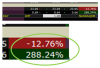
Perhaps my example could be misunderstanding, I bought a put, so you see price of underLying going down and the price of options increasing

For my experience if the underlying grows up 5% in few hours (explosion of volatitity), an atm options could increase till 100% (i usually use 80% as profit target)
IMO .......... 80% profit target isn't enough for a long option position - profit target should be 100%. Most trades will lose money so you need that 100% profit target.
Break down of buying options:
- Go for a 100% profit target when you open the trade.
- Weekly OTM options are best - maximum duration 1 month to expiry.
- Most trades will lose money - 100% loss is very common.
- Some trades will produce far more than a 100% return - these are gravy and vital to your success.

Hi OptionGuru thanks for your advices,
I think everything depends on how you approach the market
- about the percentage target, 80% isn't bad if you open and close your positions in the same day (as I do applying one of my trading systems). 100% is also a reasonable target and I agree it's quite common for trades lasting more than one day;
- about the duration, I agree: no more than 30 days;
- I like to work with an high percentage of profictable trades (at least 70%), losing trades aren't so many;
- for other operations lasting more than one day I don't use targets;
I think everything depends on how you approach the market
- about the percentage target, 80% isn't bad if you open and close your positions in the same day (as I do applying one of my trading systems). 100% is also a reasonable target and I agree it's quite common for trades lasting more than one day;
- about the duration, I agree: no more than 30 days;
- I like to work with an high percentage of profictable trades (at least 70%), losing trades aren't so many;
- for other operations lasting more than one day I don't use targets;
But, but, but, I am looking at it purely from a return on investment point of view. To the economists and financial gurus you are correct, to me though, intuitively the only thing that matters is how much I get back for what I put in (cost of the long options) on an annualized basis? Otherwise, how else should I treat my investment?You shouldn't compare %age returns of the option to the underlying. You need to compare the option notional (stockprice*option contracts) to the underlying notional (stockprice*shares) for it to be an apples to apples comparison.
Regards,
May I ask how do you determine/know your profit target/potential is 80% vs 100% when you enter a trade? I appreciate your advice.IMO .......... 80% profit target isn't enough for a long option position - profit target should be 100%. Most trades will lose money so you need that 100% profit target.
Break down of buying options:
- Go for a 100% profit target when you open the trade.
- Weekly OTM options are best - maximum duration 1 month to expiry.
- Most trades will lose money - 100% loss is very common.
- Some trades will produce far more than a 100% return - these are gravy and vital to your success.
Another comment: It is very difficult day in and day out to sustain a bunch of losses and not give up or got wipe out. For me, a few wins were able to cover all the losses but it sure is depressing most of the time, so I am looking for a way not to take all these losses. Perhaps those that said selling was a better way to go made a good point, at least psychologically.

May I ask how do you determine/know your profit target/potential is 80% vs 100% when you enter a trade? I appreciate your advice.
I don't want to speak for OptionGuru, but here is how i look at it.
You get your target from your chart of the underlying instrument. Say you see IWM trading down hard into a daily support that just happens to be a 2nd HL. The premium is going to be decreasing as the emotion of the move down is playing out. You're trying to catch the falling knife, betting the support holds and you get a short term squeeze up. If this is happening on Wednesday or Thursday all the better. If it works, you can make 100% or better on the SS without the risking getting stopped trading the TF or IWM outright.
Your stop is the premium you paid to participate.