
Are all price patterns the same? (examples)

Quote from 1a2b3cppp:

Market internals = DOM?


Last time I asked you what held/failed meant, you said this:


I'm going to need examples. What is "multiple adjacent bar intervals?" My command of English is excellent but I really have no idea what you just said.

Why 2m?


How does one know if oil was relevant?

The market internals for the the NYSE and Nasdaq Advancing versus Declining for Price and Volume as well as the TICK. Also the $VIX, the Cash premium to the ES, and anything else you find informative wrt the order flow in the cash market.

The discussion of the GBP was an example. Of note, the fact that GBP presented 60m 1.53 Failed Bid this morning as EUR presented 60m 1.30 Failed Bid is very informative in the context of ECB overnight operations. Cause and Effect...

I use Month, Week, Day, 300m (24hr instruments), 60m, 10m, 2m, and 24s depending on my needs. For intraday Setups I watch the 10m, 2m, and 24s.

If Oil is very active then it will be relevant. Same for AAPL since it is 10% or so of the $NDX. There are occasions in which the entire market is just waiting for Oil or AAPL to calm down before proceeding.
 
Quote from 1a2b3cppp:

At 11:11 the ES was at 1645.75 and then that announcement came at 11:12 and that's why price went up to 1647.50 over the next 4 minutes? Why? Price's rate of change doesn't seem any different in those 4 minutes than over the rest of the morning leading up to it. If you follow the "trend" price seems like it would've gone up there anyway. I don't see anything happening at 11:12 that seems out of the ordinary.

IMO ES was going there because of the news and sold on the news as conveyed by price quickly returning to SPX 1648 area.
 
Quote from Lucrum:


Has the OP considered simply identifying a trend, waiting for a correction, then simply jumping on board at the first sign the trend is resuming? Obviously there needs to be a trend of some sort in the first place. Also obviously what appeared like a resumption of trend initially will sometimes morph into a congestion or a trend reversal. Hence the need for some risk management. But at least it would give you a starting point.

These are Pivot Events, Held Bids/Offers and Failed Bids/Offers. Same as it ever was.
 
Quote from horton:

The market internals for the the NYSE and Nasdaq Advancing versus Declining for Price and Volume as well as the TICK. Also the $VIX, the Cash premium to the ES, and anything else you find informative wrt the order flow in the cash market.

How are Advancing vs. Declining useful for predicting direction or identifying price patterns? And VIX? What is the cash premium to the ES and how does it help with price action?

The discussion of the GBP was an example. Of note, the fact that GBP presented 60m 1.53 Failed Bid this morning as EUR presented 60m 1.30 Failed Bid is very informative in the context of ECB overnight operations. Cause and Effect...

I read your definitions again and still need an example.

I use Month, Week, Day, 300m (24hr instruments), 60m, 10m, 2m, and 24s depending on my needs. For intraday Setups I watch the 10m, 2m, and 24s.

"Depending on my needs" is vague. Which charts do you use and under what conditions?

I understand most of them but why 24s? Why not 23 or 25? What is significant about 24 seconds?

If Oil is very active then it will be relevant. Same for AAPL since it is 10% or so of the $NDX. There are occasions in which the entire market is just waiting for Oil or AAPL to calm down before proceeding.

How do you quantify "very active"? And if it is, what specific behavior makes it relevant?
 
Quote from horton:

The market internals for the the NYSE and Nasdaq Advancing versus Declining for Price and Volume as well as the TICK. Also the $VIX, the Cash premium to the ES, and anything else you find informative wrt the order flow in the cash market.


How are you using $TICK? I tested it extensively and found no useful price relation.

Kind of disappointing after John Carter hyped it up so much in his book.
 
Here's another way of looking at what I was trying to say in the first post.

Ok, people consider HH HL HH to be bullish because it means that each time price retraced it was unable to get lower than the previous low, and each time it rallied it made it even further. But by definition, all swing highs are going to be HHs, so HH is actually a bearish formation.

Then people have things like a 2t which is supposedly a top formation. Well a 2t is just a HH and another HH that are right next to each other, so again, HH is bearish.

Or head and shoulders which is a top pattern. What is head and shoulders? HH, HH, LH. The middle HH is the top.

So there are all these things that are supposed to signal the top but really they are just some form of HH. Well, unless it's a DT.

Knowing in real time that it's 1) an HH and 2) the last HH is key.

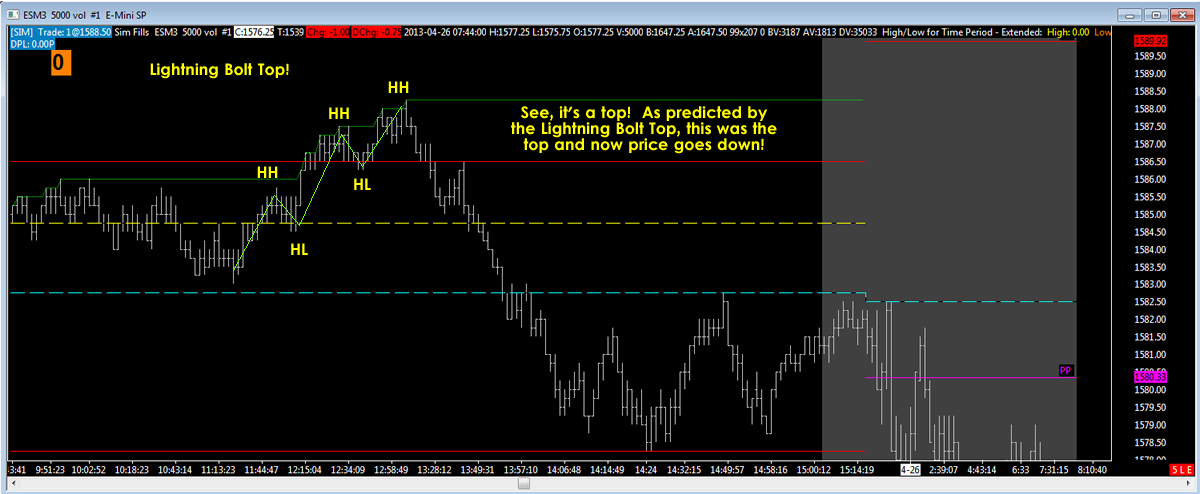
It just seems like a bunch of obvious hindsight. All the "top" patterns involve a HH somewhere. I could make up a pattern and call it the lightning bolt pattern and say it's a HH, HL, HH, HL, HH, and then that's the top.

lightning-bolt-top.png


And sometimes you'd find that pattern happening at the top, but it's not because the lightning bolt pattern is special, it's just because sometimes price will make 3 HHs before reversing. But sometimes it will make 1, or 2, or 4.

This is exactly the same reason why every trend following indicator is useless. Just because when price rallies and your indicator goes up doesn't mean that if your indicator starts going up that price is going to rally.

Just because a swing high is always marked by a HH doesn't mean that a HH is a swing high.
 
Quote from horton:

Of note, the fact that GBP presented 60m 1.53 Failed Bid this morning as EUR presented 60m 1.30 Failed Bid is very informative in the context of ECB overnight operations. Cause and Effect...

And so on...
 

Attachments

Quote from 1a2b3cppp:

How are Advancing vs. Declining useful for predicting direction or identifying price patterns? And VIX? What is the cash premium to the ES and how does it help with price action?

I read your definitions again and still need an example.

"Depending on my needs" is vague. Which charts do you use and under what conditions?

I understand most of them but why 24s? Why not 23 or 25? What is significant about 24 seconds?

How do you quantify "very active"? And if it is, what specific behavior makes it relevant?

When the Dow TICKS print -25 and the NYSE TICKS don't go down much and the ADD barely notices, this is informative. The Dow TICKs are conveying Explicit Initiative and the and NYSE Ticks are displaying Contentious Implicit Initiative. The $VIX is useful in the Daily for visualizing Explicit Initiative. The premium tells you the ES price that translates to SPX levels.

Held Bids and Offers are presented when an Instrument is sold as conveyed by Explicit Initiative but will not go down or vice versa. Failed Bids and Offers are presented when an Instrument is sold as conveyed by Explicit Initiative and will go down or vice versa. To see them you have to visualize Explicit Initiative and observe the response. For the ES the internals are useful in this regard. For an individual stock you might use relative strength versus the SPX. For currencies you might use relative strength versus the USD.

I have shown you a few of my Price charts. They all show the same thing in different Intervals. The Intervals are roughly 4x to 6x apart.

Momentum quantifies "very active". For example if Oil is "very active" into the Pit Close and the ES does not really care, this is informative.
 
Quote from IronFist:

How are you using $TICK? I tested it extensively and found no useful price relation.


Quote from horton:

When the Dow TICKS print -25 and the NYSE TICKS don't go down much and the ADD barely notices, this is informative.
 
Quote from 1a2b3cppp:

Here's another way of looking at what I was trying to say in the first post.

Ok, people consider HH HL HH to be bullish because it means that each time price retraced it was unable to get lower than the previous low, and each time it rallied it made it even further. But by definition, all swing highs are going to be HHs, so HH is actually a bearish formation.

Then people have things like a 2t which is supposedly a top formation. Well a 2t is just a HH and another HH that are right next to each other, so again, HH is bearish.

Or head and shoulders which is a top pattern. What is head and shoulders? HH, HH, LH. The middle HH is the top.

So there are all these things that are supposed to signal the top but really they are just some form of HH. Well, unless it's a DT.

Knowing in real time that it's 1) an HH and 2) the last HH is key.

It just seems like a bunch of obvious hindsight. All the "top" patterns involve a HH somewhere. I could make up a pattern and call it the lightning bolt pattern and say it's a HH, HL, HH, HL, HH, and then that's the top.

lightning-bolt-top.png


And sometimes you'd find that pattern happening at the top, but it's not because the lightning bolt pattern is special, it's just because sometimes price will make 3 HHs before reversing. But sometimes it will make 1, or 2, or 4.

This is exactly the same reason why every trend following indicator is useless. Just because when price rallies and your indicator goes up doesn't mean that if your indicator starts going up that price is going to rally.

Just because a swing high is always marked by a HH doesn't mean that a HH is a swing high.

You need to stop searching for Perfection in the Past and start searching for Probabilities and Payoff Ratios in the Present.
 
Back
Top