Another hate crime by the 13%ers

https://www.zinnedproject.org/news/tdih/move-bombing/
[emphasis added]
May 13, 1985: Philadelphia Police Bomb MOVE

On May 13, 1985, the Philadelphia Police Department dropped a C-4 bomb on the home of the MOVE organization, killing eleven people — including five children — and wiping out 61 homes in two city blocks.

[more at link]

Heavy handed? Sure. Extreme use of force? Sure.

Common thread in these cases: city officials sent police to serve arrest warrants
 
It won't be a happy Father's Day for either of them, but luckily, the baby is ok.
https://www.wftv.com/news/trending/...eputy-after-chase/4VMIAUQNLBGB5MCNNSRYTJQCA4/
Florida man throws 2-month-old baby at deputy after chase
3TIDPECUJ5C3FENFOTRCMB5MTQ.jpg

Florida man arrested John Henry James led authorities on a chase and then threw a 2-month-old boy at a deputy. (Indian River County Sheriff's Office)

June 05, 2021 at 5:38 pm EDT
By Bob D'Angelo, Cox Media Group National Content Desk
VERO BEACH, Fla. — A Florida man is accused of leading deputies on a chase and then throwing a 2-month-old child at a deputy, authorities said.

>> Read more trending news

“I’ve seen some crazy stuff but this is definitely up there,” Indian River County Deputy Jason Curby told WPEC. “It wasn’t a nice underhand handoff from a foot away, it was a throw.”

John Henry James III, 32, of Vero Beach, was charged with two felony counts of aggravated child abuse, aggravated battery on an law enforcement officer, battery on a law enforcement officer with a deadly weapon, reckless driving and resisting arrest with violence, according to Indian River County Sheriff’s Office online records. James was also cited for failure to drive within a single lane.

Dashboard camera and helicopter video released Friday showed the driver of a white Nissan Rogue sport utility vehicle, later identified as James, speeding through the town of Gifford with deputies in pursuit on May 26, WPTV reported.

After about 40 minutes of driving recklessly after an attempted traffic stop, James drove into an apartment complex where he was boxed in by deputies, WPEC reported.

According to the arrest report, James exited the vehicle and was holding a small child by its arm. The report noted that James “had his 2-month-old infant in the vehicle with him during the entire pursuit while he drove in a reckless manner to avoid apprehension.”

At the apartment complex, James ran through a breezeway, turned and threw his child at Curby, according to the arrest report.

“Deputy Curby successfully caught the infant and brought him to the front of the building,” the arrest report stated.

“It was kind of awkward. I couldn’t chase him, I couldn’t tackle him, not a whole lot I can do because he had the baby,” Curby told WPEC. “He just turned around, no regard, not a little toss or anything, he just turned around, overhand threw this 2-month-old at me from about 6 feet away.

“He’s just a cute little baby, fluffy hair, had a cute little outfit on,” Curby told the television, adding that the child was not hurt. “Luckily we were able to get the baby from him before he did trip and fall, or try to carjack somebody else.”

James was eventually taken to the ground by deputies. According to deputies, James kicked and bit at authorities as they tried to take him into custody, WPTV reported.

“You can’t throw a baby at us and expect us to treat you with kid gloves,” Indian River County Sheriff Eric Flowers said in a statement.

Deputies said James, who complained of asthma, was taken to an area hospital, WPTV reported. After James was released Tuesday, he was booked into the Indian River County Jail.

 
The Orangeburg Massacre 50 Years Later: Remembrances


https://www.zinnedproject.org/news/tdih/orangeburg-massacre/
Feb. 8, 1968: Orangeburg Massacre
Time Periods: People’s Movement: 1961 - 1974
Themes: African American, Civil Rights Movements, Racism & Racial Identity

While most people know that students were killed at Kent State in 1970, very few know about the murder of students at Jackson State (1970) and even less about South Carolina State College in Orangeburg (1968).

On Feb. 8, 1968, 28 students were injured and three were killed — most shot in the back by the state police while involved in a peaceful protest in Orangeburg, South Carolina. One of the by-standers, Cleveland Sellers, was arrested for inciting a riot and sentenced to a year of in prison. Later serving as president of Voorhees College, he was the only person to do time.


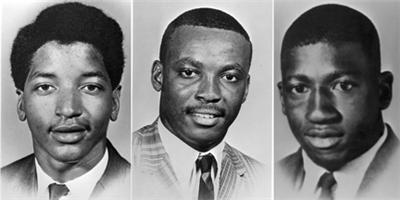
The three young men who were murdered: Henry Smith and Samuel Hammond, both SCSU students, and Delano Middleton, a local student at Wilkinson High School.

Background
In 1968, although home to two Black colleges and a majority Black population, Orangeburg’s economic and political power remained exclusively in the hands of whites. When a Black Vietnam War veteran was denied access to a nearby bowling alley, one of the last segregated facilities in town, 300 protesters from South Carolina State College and Claflin University converged on the alley in a non-violent demonstration. A melee with the police ensued during which police beat two female students; the incensed students then smashed the windows of white-owned businesses along the route back to campus. The Governor sent in the state police and National Guard.

By the late evening of Feb. 8, army tanks and over 100 heavily armed law enforcement officers had cordoned off the campus; 450 more had been stationed downtown. About 200 students milled around a bonfire on S.C. State’s campus; a fire truck with armed escort was sent in. Without warning the crackle of shotgun fire shattered the cold night air. It lasted less than ten seconds. When it was over, twenty-eight students lay on State’s campus with multiple buckshot wounds; three others had been killed. Almost all were shot in the back or side. Students and police vividly describe what they experienced that night.

Journalists remember that the Governor and law enforcement officials on the scene claimed police had fired in self-defense. The Associated Press’ initial account, carried in newspapers the morning after the shooting, misreported what happened as “an exchange of gunfire.” The source, an AP photographer on the scene, subsequently revealed that he heard no gunfire from the campus.


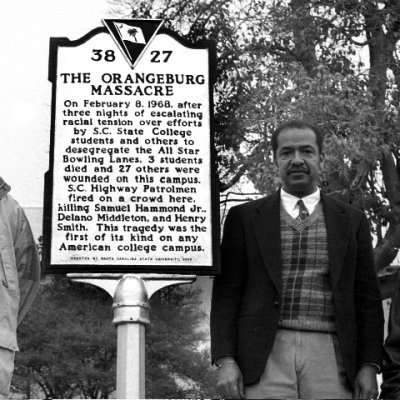
Cleveland Sellers stands beside the historic marker on the S.C. State University campus at the 2000 Orangeburg memorial. By Cecil Williams.

In Orangeburg, police fingered Cleveland Sellers as the inevitable “outside agitator” who, they claimed, had incited the students. Twenty-three years old, he had returned home, leaving his position as Student Nonviolent Coordinating Committee (SNCC) program director, to organize black consciousness groups on South Carolina campuses. Sellers had already attracted the attention of law enforcement officials as a friend of SNCC head Stokely Carmichael, who had frightened many Americans with his call for “Black Power.” Carmichael’s ideas articulated the Movement’s shift from a focus on integration to one of gaining political and economic power within the black community.

Orangeburg-650x446.jpg

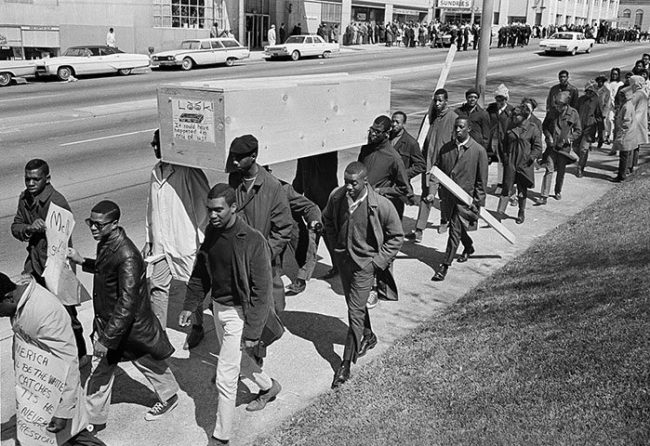
Demonstrators protest the shootings.

South Carolina officials saw Sellers as a direct challenge to their power. Wounded in the massacre, Sellers was arrested at the hospital and charged with “inciting to riot.” Though students made clear he was only minimally involved with their demonstrations, Sellers was tried and sentenced to one year of hard labor. He was finally pardoned 23 years after the incident. The U.S. Justice Department charged the nine police officers who admitted shooting that night with abuse of power. However, neither of two South Carolina juries would uphold the charges. [Description from California Newsreel.]


May 30, 1937: Memorial Day Massacre

https://www.zinnedproject.org/news/tdih/memorial-day-massacre/
Time Periods: Prosperity, Depression, & World War II: 1920 - 1944
Themes: Labor

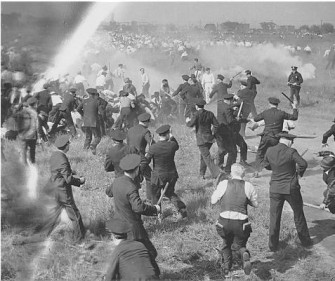
On May 30, 1937, Chicago police attacked a Memorial Day gathering of unarmed, striking steelworkers and their families. The police shot and killed ten of the strikers. Read an essay below by renowned author Howard Fast and watch video clips.

By Howard Fast
Memorial Day in Chicago in 1937 was hot, humid, and sunny; it was the right kind of day for the parade and the holiday, the kind of a day that takes the soreness out of a Civil War veteran’s back, makes him feel like stepping out with the youngsters a quarter his age. It was a day for picnics, for boating, for the beach or a long ride into the country. . . Most of the strikers felt good.

Tom Girdler, who ran Republic, had said that he would go back to hoeing potatoes before he met the strikers’ demands, and word went around that old Tom could do worse than earn an honest living hoeing potatoes. The strike was less than a week old; the strikers had not yet felt the pinch of hunger, and there was a good sense of solidarity everywhere.

Because it was such a fine summer day, many of the strikers brought their children out onto the prairie to attend the first big mass meeting; and wherever you looked, you saw two-year-olds and three-year-olds riding pick-a-back on the shoulders of steelworkers.

Continue reading Fast’s full Memorial Day Massacre essay.
 
'Because they can get away with it': Why African Americans are blamed for crimes they didn't commit: Experts

African Americans make up 49% of wrongful convictions since 1989.

ByChristina Carrega
31 May 2020, 05:50
• 17 min read
MORE: How viral videos of killings of black men take a toll on black male mental health
"It's because they can get away with it. They do it because the criminal justice system is not going to give them consequences," said Gloria Browne-Marshall, professor at John Jay College of Criminal Justice.

[VIDEO AT URL]
upload_2021-6-7_17-48-32.png


A panicked white woman in New York City's Central Park calls 911 to say that a black man threatened her and her dog.

A Florida mom claims two black men abducted her son, who had autism, and was later found dead.

But the harrowing story from Manhattan was just that -- a tall tale about about a potential assailant, but a bird watcher. And the supposedly terrified mother, police say, was never confronted by two abductors, but instead has been charged with killing her son.

Both the phony 911 call and the alleged kidnapping story follow, experts say, the stereotypical notion of black men as criminals and the ingrained racism that has existed in American society for generations. Although some may find it shocking that people are still resorting to these tropes, experts say that a culture of relative impunity has allowed it.

MORE: How viral videos of killings of black men take a toll on black male mental health
"It's because they can get away with it. They do it because the criminal justice system is not going to give them consequences," said Gloria Browne-Marshall, professor at John Jay College of Criminal Justice.

More: https://abcnews.go.com/US/african-americans-blamed-crimes-commit-experts/story?id=70906828
 
Back
Top