An Interview with Dick Lindzen

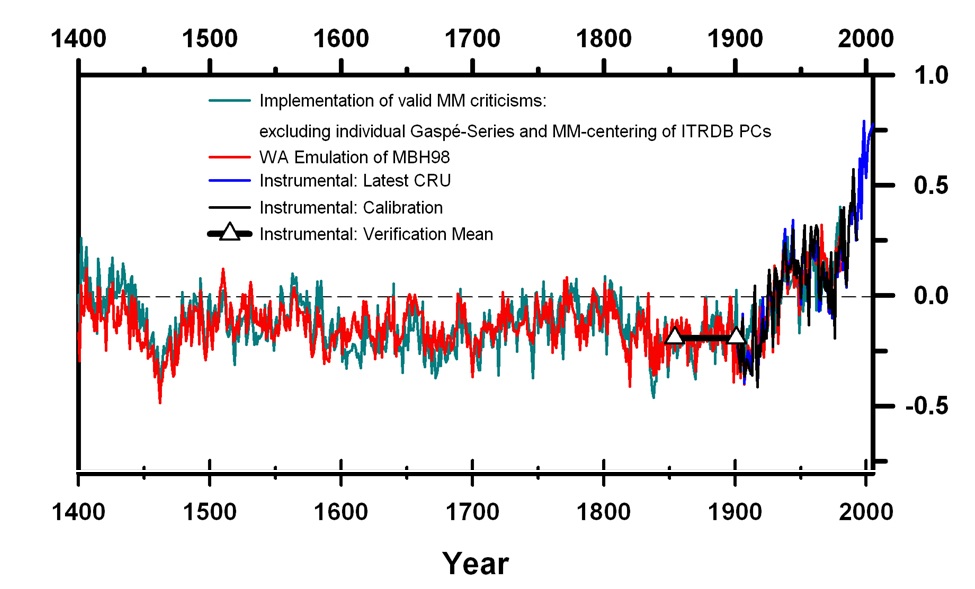
Oh, but that is a very long term trend. Over the last thousand years the trend has generally been down as per the above chart I posted. There really is no natural component to the more relevant shorter term trend over the last two hundred.

I was referring to the last four hundred. Did man contribute substantially to CO2 in 1700?
 
I was referring to the last four hundred. Did man contribute substantially to CO2 in 1700?


Not sure where you seeing warming starting in 1700. To my eye I don't see a change in trend until 1900.

NmH-Nz7SeMqsw_RhUVvbA6HiwTQ3tivt6PbYhTi6l2oTyCK83MRdVu4E8BjfsYSFHef-SFSTqgKDcB23ESTTyj6QZ6gZRBRT9E3fhH-fEqdq__cCKzcUAIBKJSU578IQ1fe2OhI=w426-h237


Perhaps you are looking at the pink line and that other one? I discount those as they are outliers. I don't see any definitive change until around 1900. But I suppose it depends on how you look at it.

Perhaps this shows it better.

WA_RC_Figure1.jpg
 
this study cited by fraudcurrents... has been pretty much shot down... but recent studies and observations of water vapor and clouds...

since this study... there have been new studies that show water vapor and clouds probably have a net cooling effect... especially in the tropics.

and more that once... I have shown fraudcurrents NASA's website where they admit they don't understand co2 impact on clouds or even the impact of clouds themselves on temperature.


in addition to what lucrum stated the point is this level of warming was natural in the past.
And we really don't know what the real level of co2 was... as we were not there to measure it.


Of what relevance is the "Medieval Warm Period"?
piezoe you are so full of shit that it's not even funny. Again with the fool/fraud/whore Murray Salby who the real scientists laugh at. Why is everyone of the scientists you refer a fool or fraud or whore to the fossil fuel interests? It's like if you say the name enough there will be some respect conferred.

*******************************************************************


A study by GISS climate scientists recently published in the journal Science shows that atmospheric CO2 operates as a thermostat to control the temperature of Earth.

There is a close analogy to be drawn between the way an ordinary thermostat maintains the temperature of a house, and the way that atmospheric carbon dioxide (and the other minor non-condensing greenhouse gases) control the global temperature of Earth. The ordinary thermostat produces no heat of its own. Its role is to switch the furnace on and off, depending on whether the house temperature is lower or higher than the thermostat setting. If we were to carefully monitor the temperature of the house, we would see that the temperature does not stay constant at the set value, but rather exhibits a "natural variability" as the house temperature slips below the set value and then overshoots the mark with a time constant of minutes to tens of minutes, because of the thermal inertia of the house and because heating by the furnace (when it is on) is more powerful than the steady heat loss to the outdoors. If the thermostat is suddenly turned to a very high setting, the temperature will begin to rise at a rate dictated by the inertia of the house and strength of the furnace. Turning the thermostat back to normal will stop the heating.


Figure 1. Attribution of individual atmospheric component contributions to the terrestrial greenhouse effect, separated into feedback and forcing categories. Dotted and dashed lines depict the fractional response for single-addition and single-subtraction of individual gases to either an empty or full-component reference atmosphere, respectively. Solid black lines are the scaled averages of the dashed and dotted line fractional response results. The sum of the fractional responses must add up to the total greenhouse effect. The reference model atmosphere is for 1980 conditions.
+ View larger image or PDF

Atmospheric carbon dioxide performs a role similar to that of the house thermostat in setting the equilibrium temperature of the Earth. It differs from the house thermostat in that carbon dioxide itself is a potent greenhouse gas (GHG) warming the ground surface by means of the greenhouse effect. It is this sustained warming that enables water vapor and clouds to maintain their atmospheric distributions as the so-called feedback effects that amplify the initial warming provided by the non-condensing GHGs, and in the process, account for the bulk of the total terrestrial greenhouse effect. Since the radiative effects associated with the buildup of water vapor to near-saturation levels and the subsequent condensation into clouds are far stronger than the equilibrium level of radiative forcing by the non-condensing GHGs, this results in large local fluctuations in temperature about the global equilibrium value. Together with the similar non-linear responses involving the ocean heat capacity, the net effect is the "natural variability" that the climate system exhibits regionally, and on inter-annual and decadal timescales, whether the global equilibrium temperature of the Earth is being kept fixed, or is being forced to re-adjust in response to changes in the level of atmospheric GHGs.

This assessment comes about as the result of climate modeling experiments which show that it is the non-condensing greenhouse gases such as carbon dioxide, methane, ozone, nitrous oxide, and chlorofluorocarbons that provide the necessary atmospheric temperature structure that ultimately determines the sustainable range for atmospheric water vapor and cloud amounts, and thus controls their radiative contribution to the terrestrial greenhouse effect. From this it follows that these non-condensing greenhouse gases provide the temperature environment that is necessary for water vapor and cloud feedback effects to operate, without which the water vapor dominated greenhouse effect would inevitably collapse and plunge the global climate into an icebound Earth state.

Within only the past century, the CO2 control knob has been turned sharply upward toward a much hotter global climate. The pre-industrial level of atmospheric carbon dioxide was about 280 ppm, which is representative of the interglacial maximum level of atmospheric CO2. During ice age extremes, the level of atmospheric CO2 drops to near 180 ppm, for which the global temperature is about 5 °C colder. The rapid recent increase in atmospheric CO2 has been attributed to human industrial activity, primarily the burning of fossil fuels. This has pushed atmospheric CO2 toward the 400 ppm level, far beyond the interglacial maximum. The climate system is trying to respond to the new setting of the global temperature thermostat, and this response has been the rise in global surface temperature by about 0.2 °C per decade for the past three decades.

http://www.giss.nasa.gov/research/briefs/lacis_01/

 
the blot post you cited is a clown's critique full of strawmen and b.s. and misinformation?


In this article I'm going to show how silly Murry Salby's "hypotheses" are (as archived here). There's a lot of "wrong" with Salby's efforts but two things stand out the most in my view:

  • Murry Salby is a greenhouse effect denier and
  • Murry Salby thinks billions of tonnes of carbon can disappear off the face of the earth by magic.


Following on from my last article, Anthony Watts has posted a few diagrams of Murry Salby's, provided not by Murry but by Christopher Monckton. I don't know who wrote the text. I'll take the opportunity Anthony Watts and Christopher Monckton have provided to do what HotWhopper does - demolish disinformation.

This will be a dull article, I'm afraid. Murry Salby's slide series ranks with this "stupid" list I compiled some months back. It's mind-numbingly stupid - not earning the "stupid and funny" ranking of "OMG it's insects".

http://blog.hotwhopper.com/2013/11/denier-weirdness-defending-indefensible.html
 
you really enjoy being such a troll? I only had to go back a page or two to find it?

In part. We've been in a warming trending since the 17th century. That's natural. However, the extent of the increase and the rapidity of the increase are logically due to the extraordinary amounts of fossil fuels burned during the English and American industrial revolutions.

We are and have been, in effect, short-circuiting a natural process (in addition to all the other damage we've done).


What warming that db is referencing that is so unprecedented are you talking about?
 
Whether or not some other period in the distant past was warmer or not is irrelevant. What matters is the reasons for the current increase. If it is man-made, and the preponderance of evidence and the consensus of opinion are that it is, there is no reason to believe that it will coast to a stop at the same level as at the MWP, nor is there any reason to believe that it will not get worse and reach a tipping point from which there will be no retreat. To dismiss something as a normal cyclical mechanism that we just happen to trigger and exacerbate will be of little comfort to those who must suffer through it.

I largely agree with you, but disagree on what I consider important points. I am in agreement that it matters what the cause is for the increase seen from he late 19th Century up until approximately 1997. The problem is that a few tenths of a degree increase is so small compared to natural variation that we are at a loss to distinguish it. Being able to distinguish it is not critically important however. What is, is whether Hansens hypothesis is correct, because if it is, we could be in serious trouble! But we can't escape the reality that there has been no net detectable increase since about 1997 (or so), and that considerably weakens the probability of Hansen having been correct. So we are talking now about the increase between the late 19th Century and about 1997. It would be nice to know what caused that, but it is far more important to know whether Hansen's hypothesis is correct.

A place where we would disagree is what the preponderance of evidence is telling us and of the importance of public opinion. The preponderance of the evidence is telling us that the Hansen's hypothesis is wrong, and it is telling us unequivocally so. Consequently we do not have to be concerned about reaching a Hansen "tipping point" due to positive feedback beyond which we would see a rapid uncontrolled increase in temperature.

We should not decide scientific questions by opinion polls nor media hype. We should let all that stuff, including marches and banner waving, go in one ear and out the other.

We should, on the other hand, pay close attention to what the majority of meteorologists and atmospheric physicists are saying, and they are now saying what Lindzen is saying (the majority, not all). They are saying we can't tell the slight increase in temperature we experienced over the past 150 years from the natural variance of climate. It is, however, consistent with the measurable rise in CO2 plus the other non-condensing greenhouse gases. And although we as yet don't have a way to distinguish what fraction of the increase in CO2 is man caused, because CO2 exchanges far more rapidly than Hansen originally thought, and the natural sourcing and sinking is two orders greater than man's emissions. (Many have just assumed that the increase is mostly due to man because the increase very roughly approximates the amount we have emitted.) The early hope that man's fossil fuel emissions had a unique isotope signature have been dashed upon the rocks by discovery that even larger natural emissions have the same signature.

Most importantly, for the purpose of addressing the validity of Hansen's hypothesis, is any evidence of positive feedback. (See Lindzen's talk before the House of Commons for much detail on this matter.) We now have -- in Hansens's defense, we didn't in 1988 -- unequivocal evidence that there is feedback, but it is slightly negative, not positive as required by Hansen. That is to say that the response of our biosphere to a temperature rise is to dampen it via negative feedback, rather then amplify it via positive feedback. This is consistent with the known history of the atmosphere. It's also logically gratifying, because if the feedback were positive none of us should be here! (This is something Hansen, unaccountably, missed in putting forth his hypothesis.) The satellite data, which is the best and most reliable data we have, shows us the feedback is negative, not positive.. Those are facts. We should accept them. If we don't, we will surely look like fools to future generations.

What should we do then. Well, we should still be conscious of our CO2 emissions and, for several good reasons, try to convert, at a reasonable pace, to alternate forms of energy with a smaller carbon footprint. And we should be good protectors of our biosphere. We need to protect our oceans and our forests from pollution and destruction. The animal kingdom's success is integrally linked with that of the plant kingdom. We must avoid over population. Birth control is hugely important if we want to be kind to our environment! I would say that if one feels the urge to take up a banner and march, then by all means march for birth control.

We should avoid, however, making public policy based on an incorrect hypothesis. To do so is nonsense.

Thank you, by the way for not calling every one you disagree with, including those scientists you've never met who have long-standing international reputations in atmospheric physics, "idiots and frauds". How very refreshing it is to have a discussion without name calling.
 
Last edited:
you really enjoy being such a troll? I only had to go back a page or two to find it?

And you claim that the amount of CO2 released into the atmosphere over the last hundred years is no different that at any other time during the last millenium?
 
Back
Top