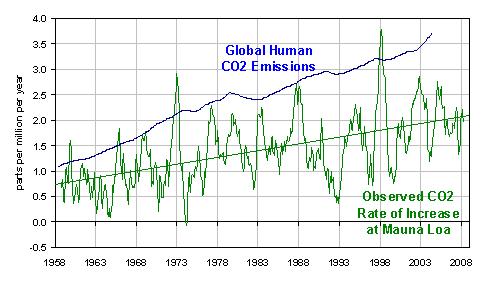
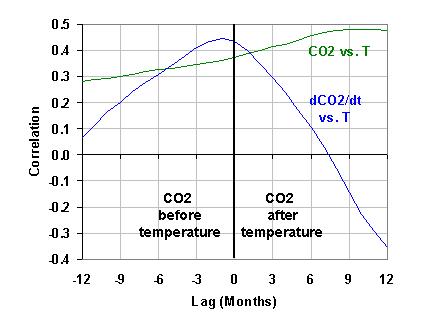
and before you try your typical leftist ad hom on the messenger instead of dealing with the science and the data... .
Roy Warren Spencer is a
climatologist,
[1] Principal Research Scientist at the
University of Alabama in Huntsville, and the U.S. Science Team leader for the Advanced Microwave Scanning Radiometer (AMSR-E) on NASA's
Aqua satellite.
[2][3] He has served as Senior Scientist for Climate Studies at NASA's
Marshall Space Flight Center.
[2][3]
He is known for his
satellite-based temperature monitoring work, for which he was awarded the
American Meteorological Society's Special Award.
[3]
-------------------
Negative cloud feedback[edit]
In 2007, Spencer and others published a paper in
Geophysical Research Letters regarding negative
cloud feedback in the tropics that potentially supports
Richard Lindzen's
Iris hypothesis, which proposes that as the tropical atmosphere warms, cirrus clouds decrease, allowing infrared heat to escape from the atmosphere to outer space.
[9][10] Spencer stated, "To give an idea of how strong this enhanced cooling mechanism is, if it was operating on global warming, it would reduce estimates of future warming by over 75 percent. [...] Right now, all climate models predict that clouds will amplify warming. I'm betting that if the climate models' 'clouds' were made to behave the way we see these clouds behave in nature, it would substantially reduce the amount of climate change the models predict for the coming decades."
[10][11]
Cloud formation and temperature change[edit]
In 2008, Spencer and William Braswell published a paper in the
Journal of Climate which suggests that natural variations in how clouds form could actually be causing temperature changes, rather than the other way around, and could also lead to overestimates of how sensitive the Earth's climate is to greenhouse gas emissions.
[12][13] Spencer stated, "Our paper is an important step toward validating a gut instinct that many meteorologists like myself have had over the years, [...] that the climate system is dominated by stabilizing processes, rather than destabilizing processes - that is, negative feedback rather than positive feedback."
[14]
Energy lost to space as compared to climate models[edit]
In 2011, Spencer and Braswell published a paper in
Remote Sensing concluding that more energy is radiated back to space and released earlier than previously thought.
[15][16] Spencer stated, "The satellite observations suggest there is much more energy lost to space during and after warming than the climate models show. There is a huge discrepancy between the data and the forecasts that is especially big over the oceans."
[16][17][18]
The paper was criticized by mainstream climate scientists.
[19][20] Kerry Emanuel of MIT, said this work was cautious and limited mostly to pointing out problems with forecasting heat feedback.
[19]
The editor-in-chief of
Remote Sensing, Wolfgang Wagner, later resigned over publication of Spencer and Braswell (2011),
[21] stating, "From a purely formal point of view, there were no errors with the review process. [...] the problem I see with the paper by Spencer and Braswell is not that it declared a minority view ...but that it essentially ignored the scientific arguments of its opponents. This latter point was missed in the review process, explaining why I perceive this paper to be fundamentally flawed and therefore wrongly accepted by the journal."
[22] Wagner added he, "would also like to personally protest against how the authors and like-minded climate sceptics have much exaggerated the paper's conclusions in public statements".
[21][22]
Spencer responded that Wagner's assertion was wholly inaccurate, "But the paper WAS precisely addressing the scientific arguments made by our opponents, and showing why they are wrong! That was the paper’s starting point! We dealt with specifics, numbers, calculations…while our critics only use generalities and talking points. There is no contest, as far as I can see, in this debate. If you have some physics or radiative transfer background, read the evidence we present, the paper we were responding to, and decide for yourself."
[23]
Andrew Dessler later published a paper opposing the claims of Spencer and Braswell (2011) in
Geophysical Research Letters.
[24]
Views[edit]


.png)