
"We believe that we're going towards a nearly sea ice-free Arctic in the next 10-20 years," says Overland. "The question now is: Do you wait for more perfect information, or do we act on incomplete information?"
NOAA scientist James Overland
I see the problem we face a little differently. I see it as one in which we have very unreliable ability to predict future climate, and that, at best, we can guess that future climate will be like past climate with about the same variability. At this point, in my opinion, the only thing we are able to model with some accuracy, yet imperfectly, is the effect of the non-condensing greenhouse gases in the absence of changes in other important climate affecting phenomena. Those other models, which assume various degrees of positive feedback to produce a result that agrees with preconceived notions, are so unreliable, IMO, that to use them to make predictions, upon which public policy is predicated, is an absurdity.
We do have a fair, with large error bars, indication that there has been some warming over the past 150 years at a time when CO2 and other non-condensing greenhouse gasses have also risen. The temperature rise is, so far, negligible compared to natural temperature variability, and less than predicted by modeling the effects of rising non-condensing, greenhouse gases.
There is no ability to reliably model other hugely important influences on our climate, clouds and water vapor, for example. And we certainly cannot accurately predict the future magnitudes, at a given time, of the various components that would have to be included in any reliable, comprehensive, climate model.
We can't rule out the possibility that man is significantly affecting the Earth's climate, nor can we, at this point, rule it in! It's just a big guess. It is, again IMO, just as likely as not that we are affecting our climate by some mechanism other than CO2 emission. But unless that's true, AND we know the correct mechanism!, we can't be expected to create effective public policy.
There is only one policy that would be effective independent of mechanism, and that is population control! Specific measures, such as carbon emission control, depend for effectiveness on having the mechanism right. Sadly, we do not yet have the mechanism right! The reason I can say that with confidence is that we have direct observations that are not in agreement with the proposed mechanism. A single observation of that nature is enough to justify the rejection of the mechanism. In the present case we have multiple observations that run counter to the proposed mechanism for catastrophic global warming!
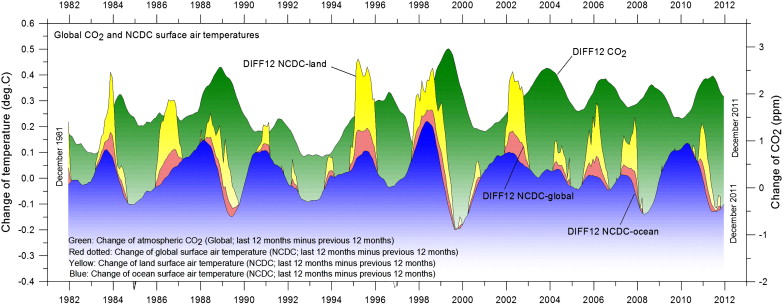
All we have are hypotheses, and among these the Hansen hypothesis seems to be wrong. Carbon dioxide concentration appears to be mostly driven by temperature rather than man's emissions, and the rise in CO2 concentration at the time of man's increasing his CO2 emissions appears fortuitous.
The Hansen hypothesis is, by the way, not that CO2 is a greenhouse gas and that a rising concentration should cause some warming. There is general agreement on that. That's not his hypothesis at all. His hypothesis is that man's emission of CO2 is causing the Earth to warm and that the warming, via positive feedback, will cause temperature to rise exponentially rather than linearly, producing a harmful temperature excursion. All direct observational evidence so far indicates the Hansen hypothesis is incorrect. We should not base public policy on an hypothesis that has been shown to be incorrect!
My best guess as to why the Hansen hypothesis at first seemed to be correct, but now appears incorrect, is that several assumptions made in the early models, models that seemed to be in agreement with Hansen, are wrong. One is that the turnover of CO2 is very slow. In fact, it is fairly rapid. (Biota responds almost instantaneously to changes in CO2 concentration.) Another is that the effect of a small increase of CO2 gets amplified by increasing water vapor and clouds. But it now appears that water vapor and clouds, our atmosphere's major greenhouse components, also have negative feedback contributions and that their overall effect is closer to neutral. They seem to have more of a moderating influence than one of amplification. Yet another source of error was very bad guesses at the magnitudes of natural sourcing and sinking of CO2 compared with the magnitude of man's CO2 emission. Consequently, we did not pay enough attention to the possibility that the correlation between rising CO2 and rising anthropomorphic emissions could be fortuitous. (This was well before we had much satellite data.) Another source of error, and this led us on a wild goose chase, was not recognizing that there were bigger natural sources of CO2 with the same isotope signature as fossil fuel CO2.
I could go on. But I don't want to imply that we were doing bad science because we made these errors. It's just a very difficult problem to sort out all influences on climate and their relative magnitudes, because climate is dynamic and is always changing. It's been impossible to accurately model it and include simultaneously all the important influences. These early climate mistakes are completely understandable considering how difficult this problem is.
As long as their are humans doing science we will have egos involved, but now we have politics and profits too. The issue has become unusually divisive, down to the point of name calling and insult hurling. Emotional involvement can blind us and destroy objectivity. I'm guessing, and I hope I'm wrong, that this climate issue will eventually be recognized as one of the great fiascoes of all time.

.png)