
Do we then just take each one as they come and let them play out, or do we look for reversals on charts that are longer in nature. If so, what would be the minimum time frame that we could use for long term reversal?The future is unknown. That's the synthesis of all this inquiry. Certainty isn't in the market, and can only be hoped to be attained in our actions. In other words, actions can have certainty but not the outcome of those actions.
Knowing where and when the ultimate reversal is is only determined in hindsight (unless one is a time traveler). A trader can only choose to enter at certain higher probability locations and then take it from there. One of those entry points might turn out to be the turning point.
Gringo

You are using an out of date browser. It may not display this or other websites correctly.
You should upgrade or use an alternative browser.
You should upgrade or use an alternative browser.
All Market Reversals Begin on the 1 Minute Chart
- Thread starter Buy1Sell2
- Start date

Do we then just take each one as they come and let them play out, or do we look for reversals on charts that are longer in nature. If so, what would be the minimum time frame that we could use for long term reversal?
If price hits 5010 on some index and goes down, using any bar interval, be it 1m, 2m, 5m, 1hr, 5hr, day, week, or month will still show 5010 as the top before price turned down. None of the intervals would tell whether it is a top in advance. It could be only a pullback but not a full fledged down turn.
Looking for tops is not what I do. I look for ranges and trend channels and bet price is going to revert to the mean or median from the extremes. One of these might turn out to be tops but it won't be because I foresaw it as a top, it would be because of a coincidence that I chose to short because price was turning around at an important level.
To me it seems you view price as being not continuous. You may intellectually understand the concept but don't really see it that way, or breathe it that way. I have gone through that stage myself and it did take some time and effort to see things differently. I can understand why it could be problematic to explain this concept and the frustration it might cause. A lot of times it does seem random gibberish when the eye isn't attuned to seeing what is. Those who do start seeing things differently know the day they got that clarity. It's not something that happens unknowingly, or slips through the mind in secret, but is more like a sudden paradigm shift that jolts the mind. More like fireworks in the head.
An analogy would be those pictures that show the old and the young woman at the same time. Before the second part of the image is recognized it sounds crazy to hear from someone not seeing the same image. Afterwards it seems all so obvious. The epiphany of seeing price as continuous is life altering but still requires post epiphany work to refine and plan things. You might have seen I still make mistakes with my entries in my journal. Despite my seeing things better I am at times slow, and at times hesitant, and a host of other weaknesses, despite having the ability to read price and knowing the important level where price has a greater chance of doing something. And yes, there's also the need to control how much is one willing to commit and money management. Trading profitably is a culmination of a multitude of things and self-control is high on that list.
I am happy if what you do works for you. There are so many methods and ways to make money that it is baffling, but this one is in sync with my personality and works for me. Some like Judo and others Tai-Kwondo. Some prefer Ninpo and others Hapkido. Some Kick Boxing and others Systema. I prefer Scribbles over another system.
The kind of questions you're asking gives me information about how you see things. It tells me that however good or bad this method is, you're not in sync with it. The questions you are asking are all valid and many people have asked them before. What's problematic is that my explanations won't do any good unless you start seeing price the way I see it. Due to the dynamic nature (always changing) an entry even when the position is in the positive can start to look not suitable and prompt an exit. This isn't an exit because the trader was terrified of being wrong and craved some profit to feel right. This was because the price didn't behave as was expected.
Now tell me, how am I to explain to you this change in behavior unless you've seen it in multiple variations over some time. Are you even aware or actively looking for such a behavior? If not, then how can you ever hope to understand it when it does show up? One analogy would be an indicator showing a higher low when price had a double bottom. Now this same behavior though so easily discernible isn't going to mean much to a person who's not used to the indicator, or is just starting to use it. That person is only used to buying when indicator is extremely oversold and selling when it's extremely overbought. You on the other hand can not only see the overbought/oversold position of the indicator, but also the divergence when it shows up. For you it's so obvious that it is self evident, yet that other trade is confused.
That trader is going to blame you for coming up with random criteria for an entry. He's going to ask you"But how do you know this is going to work out for you?". You would probably say you understood the dynamic change and realizing the greater probability entered. There would be times when that higher low wouldn't work out. Would that mean it was a trick on your part to fool the other trader or hide some secret recipe? To learn what you learn the other trade will have to get his hands dirty and spend some time with the indicators and see in what conditions they fail and in what conditions they're likely to work better.
Without the ability to read price and see it as continuous, without understanding that for each person's price risk and information risk aren't the same, and without observing price without indicators, it could turn out that this whole way of looking at price might remain a mystery to you. It's not a blot on your personality or your ability as a successful trader. If you can't get yourself to delve deeper or read the principal documents then it's telling you that your personality isn't compatible with the method. Your questions have become better and pertinent over time, but still you're asking them as if to avoid admitting you want to know more. I don't know how wonderfully your current system is working for you, but is there a desire somewhere to be able to time the market better? To me it seems that you're trying to learn this in a half-hearted way but can't admit it to yourself that you want to learn. To your subconscious would it imply some shortcoming in the way things currently are or some kind a dissatisfaction?
You're a better judge of your life and conditions. All I can do is wish you all the best and hope that we all end up making oodles of money and remain happy.
Gringo
Last edited:
Try Donchian trading...sell the lows and buy the highs; it worked for himThe future is unknown. That's the synthesis of all this inquiry. Certainty isn't in the market, and can only be hoped to be attained in our actions. In other words, actions can have certainty but not the outcome of those actions.
Knowing where and when the ultimate reversal is is only determined in hindsight (unless one is a time traveler). A trader can only choose to enter at certain higher probability locations and then take it from there. One of those entry points might turn out to be the turning point.
Gringo
Comes down to how often you can lose in number of trades, how much you willing to lose per trade and do you have enough in your account to lose a great deal if you doing the futures only. If buying options you have a little more time to hang onto the trade and of course limited loss. I was taught and read using monthlies as starting point if I wanted to do a stop and reserve, which in a way is similar to Donchians' 4 week breakout. Lower the timeframe, greatest amount of false signals-smallest risk. Going to larger timeframe, lower number of losing trades, much higher risk. So trade offs.Daily and higher. Major Market reversals

Chart didn't show up?Comes down to how often you can lose in number of trades, how much you willing to lose per trade and do you have enough in your account to lose a great deal if you doing the futures only. If buying options you have a little more time to hang onto the trade and of course limited loss. I was taught and read using monthlies as starting point if I wanted to do a stop and reserve, which in a way is similar to Donchians' 4 week breakout. Lower the timeframe, greatest amount of false signals-smallest risk. Going to larger timeframe, lower number of losing trades, much higher risk. So trade offs.
Attachments
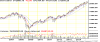
Which is the correct one minute chart reversal to take that is the beginning of a long term reversal?
This is wrong reversal occurs when majority of investors (mostly including big institutional investors) start to believe in long-term reversal and therefore change supply/demand balance either starting to buy or starting to sell in big volumes.
You may find the lowest or highest point of a long-term and zoom it into 1-minute time-frame but this is not the point whether reversal occurred. It could be the point when one of the "Big Guys" extra money to buy or to sell, but there is no way that at that point you can say this is a reversal. If other institutional investors pick up this action them we may have a reversal, but this is the longer than 1-minute process for long-term trends, and it can take even several months, especially at a long-term resistance level.
In reality, all charts do is show the past. There is no present there, no matter how much the price action folks wish for it. surf
A price chart is an attempt to model relevant aspects of price change. Price change is not linear displacement, whether vertical, horizontal or oblique. Nonetheless, price change can be represented as vertical displacement and time elapsed as horizontal displacement. Such a model, however, invariably supports relationships that does not correspond to anything in the original process.The angular inclination of a trend on a price chart is a visually striking feature of this representation. Such angles have no intrinsic meaning for the price series, but this is one of the many factors (along with our facility for pattern recognition and wishful thinking) that contributes to our interpreting more from price charts than rigorous testing reveals is there.
- William Eckhardt
A price chart is an attempt to model relevant aspects of price change. Price change is not linear displacement, whether vertical, horizontal or oblique. Nonetheless, price change can be represented as vertical displacement and time elapsed as horizontal displacement. Such a model, however, invariably supports relationships that does not correspond to anything in the original process.The angular inclination of a trend on a price chart is a visually striking feature of this representation. Such angles have no intrinsic meaning for the price series, but this is one of the many factors (along with our facility for pattern recognition and wishful thinking) that contributes to our interpreting more from price charts than rigorous testing reveals is there.
- William Eckhardt
Try Donchian trading...sell the lows and buy the highs; it worked for him
This stuff is from the 1950's! Folks still do this? It's like the Amish riding buggies down the highway--- Using the power of a computer to do charts?? you gotta be kidding me!
K...I ll make sure I get out the walkie-talkies for inside informationThis stuff is from the 1950's! Folks still do this? It's like the Amish riding buggies down the highway--- Using the power of a computer to do charts?? you gotta be kidding me!
