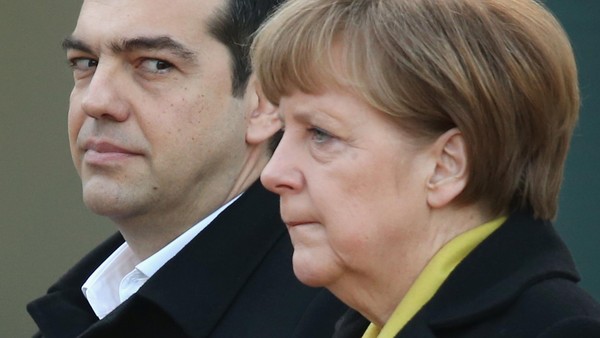
Alexis Tsipras' "open letter" to German citizens

Hmm, does this look like knee jerk reaction to you? Maybe we need to lower your zerohedge dosis?

Capture.JPG


"No Deal": Tsipras Says Creditors Did Not Accept Greek Proposal

Who could have possibly foreseen that the IMF would throw up all over the Greek "proposal"... aside from this post here "Why The IMF Will Reject The Latest Greek Proposal In Just Two Numbers" yesterday afternoon of course. In any event, moments ago Bloomberg reported that just as we wrote here yesterday afternoon, there is no deal and that Greek PM Alexis Tsipras told his associates that creditors not accepting equivalent fiscal measures has never happened before, according to a Greek govt official, who asked not to be named in line with policy.

Creditors “not accepting parametric measures has never happened before. Neither in Ireland, nor in Portugal, nor anywhere. This strange stance can hide two scenarios; they either don’t want an agreement or serve specific interests in Greece,” the official cited Tsipras as saying."

As a reminder, Tsipras is meeting Wednesday with European Central Bank President Mario Draghi, International Monetary Fund Managing Director Christine Lagarde and European Commission President Jean-Claude Juncker in an effort to reach a deal before Greece’s bailout expires and about 1.5 billion euros ($1.7 billion) in payments come due to the IMF on June 30.

The reaction across European asset classes was kneejerk lower...


... although it has since bounced back modestly as "hopes" that this final final deal, which was just scuttled, will be revised and lead to yet another favorable conclusion. They don't call it climbing the wall of Greek rumors for nothing.

As for Tsipras suggesting that Troika does not want an agreement, he is absolutely correct. Recall "Goldman's "Conspiracy Theory" Stunner: A Greek Default Is Precisely What The ECB Wants"... the same Goldman that blessed a Lehman bankruptcy and got precisely what it requested.

In any event, the ball is now in Greece's court...

  • CREDITORS SAID TO HAND GREEK GOVT REVISED PROPOSAL
... also as we predicted, where either the Greek negotiators will finally enact the "dreaded" pension cuts, or else the Troika will be able to wash its hands of a Greek default and blame it all on Greek intransigence. As a further reminder, at this point it is all about who gets the blame for a "Grexident."
 
your guy Mish really seems to have a hard-on for Greece and Europe, huh? All that from the Californian or West Coast wilderness, does that not strike you as a bit odd?

If you say so, volly. When you're right, you're right. And you? You're always right!
 
Greek drama poses long-term risk for euro
Roger Blitz

3598429a-28f4-4522-b84f-fc4e259c5d02.img
©EPA
Europe has no safe route in dealing with Greece's debt crisis

Jokes about the eurozone were all the rage four years ago, at the height of the debt crisis (“A Greek, an Irishman and a Portuguese go into a bar and order a drink. Who picks up the bill? A German”).

Black humour has been less in evidence over this year’s Greek saga. Is it because the consequences of default and Greece’s exit from the euro are deadly serious, or because the market is confident that the prospect of eurozone contagion will be limited?

Both theories may be true. Investors are broadly satisfied that the short-term impact on the eurozone has been neutralised and the structure of the euro can be maintained. Bank risk is a fraction of the levels of 2011, and trading in the euro as the latest crisis intensified suggests investors have for the most part largely ignored Greece.

But in the long term, they worry that Greece, whether it stays in the euro or not, has exposed the fundamental flaws of the single currency, and that the crucial concept of eurozone membership, that it is irreversible, has been fatally undermined.

What happens the next time a eurozone member risks breaching the rules of the club, wonders Paul Lambert, head of currency at Insight Investment.

“In the short term the market seems to have decided to return to business as usual,” he says. “Longer term it is also now clear that when a country is on the ropes and needs to be supported by its euro partners, then the threat of a mutually damaging euro crisis seems to be an acceptable weapon from both sides and that means the euro is not a monetary union in the purest sense.”

By kicking the Greek can down the road, Europe’s leaders may have merely heightened market sensitivity to the next political crisis.

According to David Riley, partner at BlueBay Asset Management: “The next time it looks like we are going to get an anti-establishment party coming to power in France or Italy or Spain, investors are going to be very, very nervous”.

General elections take place in December in Spain, where the radical left-wing party Podemos has been polling well.

253062c0-1a3b-11e5-8201-cbdb03d71480.img

It looms as a test of the Spanish public’s support for its government’s adoption of structural reforms demanded by the eurozone institutions. The Spanish economy is expected to grow by 2-3 per cent this year, but unemployment hovers near 23 per cent.

Will economic recovery in Spain and other peripheral eurozone countries be deep enough and sufficiently sustainable to mitigate political risk?

Ugo Lancioni, currency manager at Neuberger Berman, says the eurozone is “in a race” to achieve recovery before anti-establishment parties can harden their support. “It’s going to be about wealth and the perception of recovery,” he says.

The social and political consequences of the recovery may be severe. But structural reforms are the only way to make the single currency resilient, says Stephen Jen, head of currency hedge fund SLJ Macro. Right now, he says, “the EMU is brittle”.

Formed in 1999, the euro enjoyed a decade of relative stability until the debt crisis erupted in 2010. It is not the current crisis, but the 2010-12 version that first damaged the principle of irreversibility, says George Saravelos, strategist at Deutsche Bank.

“From the perspective of redenomination risk, the latest Greek crisis has not seen a material repricing of these risks. Underlying worries around re-denomination are likely to remain so long as political risks remain in Europe,” he says.

231c099e-1a3b-11e5-8201-cbdb03d71480.img

In a global economic climate showing signs of recovery, there is more than enough interest elsewhere to keep investors preoccupied with matters other than Greece.

In many ways, Greece is unique, says Ralf Preusser, rates strategist at Bank of America Merrill Lynch. He argues that its dependence on external financing and its unsustainable debt should not make investors more or less nervous about the future of the euro area.

“The trigger for a spillover in my mind would be the next recession when we could possibly recreate Greek circumstances elsewhere, but this doesn’t strike me as a near-term risk,” says Mr Preusser.

But the medium term is the nagging concern. The market appears supportive of the European Central Bank’s quantitative easing programme. Société Générale strategist Kit Juckes says QE has effectively “smothered” risk premiums.

But what happens to risk premiums after QE, he asks. “We’ll have to find out where private sector investor demand for European assets sets prices in a system whose structural flaws have been exposed and whose leaders’ inability to provide structural reforms for those flaws is clearly lacking,” says Mr Juckes.

That is no laughing matter.
 
...

http://syriza.net.gr/index.php/en/p...s-that-which-you-were-never-told-about-greece

Alexis Tsipras' "open letter" to German citizens published on Jan.13 in Handelsblatt, a leading German language business newspaper


Most of you, dear Handesblatt readers, will have formed a preconception of what this article is about before you actually read it. I am imploring you not to succumb to such preconceptions. Prejudice was never a good guide, especially during periods when an economic crisis reinforces stereotypes and breeds biggotry, nationalism, even violence.

In 2010, the Greek state ceased to be able to service its debt. Unfortunately, European officials decided to pretend that this problem could be overcome by means of the largest loan in history on condition of fiscal austerity that would, with mathematical precision, shrink the national income from which both new and old loans must be paid. An insolvency problem was thus dealt with as if it were a case of illiquidity.

In other words, Europe adopted the tactics of the least reputable bankers who refuse to acknowledge bad loans, preferring to grant new ones to the insolvent entity so as to pretend that the original loan is performing while extending the bankruptcy into the future. Nothing more than common sense was required to see that the application of the 'extend and pretend' tactic would lead my country to a tragic state. That instead of Greece's stabilization, Europe was creating the circumstances for a self-reinforcing crisis that undermines the foundations of Europe itself.

My party, and I personally, disagreed fiercely with the May 2010 loan agreement not because you, the citizens of Germany, did not give us enough money but because you gave us much, much more than you should have and our government accepted far, far more than it had a right to. Money that would, in any case, neither help the people of Greece (as it was being thrown into the black hole of an unsustainable debt) nor prevent the ballooning of Greek government debt, at great expense to the Greek and German taxpayer.

Indeed, even before a full year had gone by, from 2011 onwards, our predictions were confirmed. The combination of gigantic new loans and stringent government spending cuts that depressed incomes not only failed to rein the debt in but, also, punished the weakest of citizens turning people who had hitherto been living a measured, modest life into paupers and beggars, denying them above all else their dignity. The collapse of incomes pushed thousands of firms into bankruptcy boosting the oligopolistic power of surviving large firms. Thus, prices have been falling but more slowly than wages and salaries, pushing down overall demand for goods and services and crushing nominal incomes while debts continue their inexorable rise. In this setting, the deficit of hope accelerated uncontrollably and, before we knew it, the 'serpent's egg' hatched – the result being neo-Nazis patrolling our neighbourhoods, spreading their message of hatred.

Despite the evident failure of the 'extend and pretend' logic, it is still being implemented to this day. The second Greek 'bailout', enacted in the Spring of 2012, added another huge loan on the weakened shoulders of the Greek taxpayers, "haircut" our social security funds, and financed a ruthless new cleptocracy.

Respected commentators have been referring of recent to Greece's stabilization, even of signs of growth. Alas, 'Greek-covery' is but a mirage which we must put to rest as soon as possible. The recent modest rise of real GDP, to the tune of 0.7%, signals not the end of recession (as has been proclaimed) but, rather, its continuation. Think about it: The same official sources report, for the same quarter, an inflation rate of -1.80%, i.e. deflation. Which means that the 0.7% rise in real GDP was due to a negative growth rate of nominal GDP! In other words, all that happened is that prices declined faster than nominal national income. Not exactly a cause for proclaiming the end of six years of recession!

Allow me to submit to you that this sorry attempt to recruit a new version of 'Greek statistics', in order to declare the ongoing Greek crisis over, is an insult to all Europeans who, at long last, deserve the truth about Greece and about Europe. So, let me be frank: Greece's debt is currently unsustainable and will never be serviced, especially while Greece is being subjected to continuous fiscal waterboarding. The insistence in these dead-end policies, and in the denial of simple arithmetic, costs the German taxpayer dearly while, at once, condemning to a proud European nation to permanent indignity. What is even worse: In this manner, before long the Germans turn against the Greeks, the Greeks against the Germans and, unsurprisingly, the European Ideal suffers catastrophic losses.

Germany, and in particular the hard-working German workers, have nothing to fear from a SYRIZA victory. The opposite holds. Our task is not to confront our partners. It is not to secure larger loans or, equivalently, the right to higher deficits. Our target is, rather, the country's stabilization, balanced budgets and, of course, the end of the grand squeeze of the weaker Greek taxpayers in the context of a loan agreement that is simply unenforceable. We are committed to end 'extend and pretend' logic not against German citizens but with a view to the mutual advantages for all Europeans.

Dear readers, I understand that, behind your 'demand' that our government fulfills all of its 'contractual obligations' hides the fear that, if you let us Greeks some breathing space, we shall return to our bad, old ways. I acknowledge this anxiety. However, let me say that it was not SYRIZA that incubated the cleptocracy which today pretends to strive for 'reforms', as long as these 'reforms' do not affect their ill-gotten privileges. We are ready and willing to introduce major reforms for which we are now seeking a mandate to implement from the Greek electorate, naturally in collaboration with our European partners.

Our task is to bring about a European New Deal within which our people can breathe, create and live in dignity.

A great opportunity for Europe is about to be born in Greece on 25th January. An opportunity Europe can ill afford to miss.
Helluva good letter.
 
Tsipras has earned his punishment

The Greek people are enduring the consequences of their prime minister’s childish misbehaviour
6768c4ef-9d52-4fb7-98f7-096fd5bcdfca.img
©Getty

European and international officials have required thick skins this year. In Anglo-Saxon countries, they are daily lampooned as economic illiterates who caused the Greek economic crisis and have asphyxiated the economy during the past five months of negotiations. Now they are harangued by Alexis Tsipras as “extremist conservative forces” who are supposedly “blackmailing” the Greek prime minister’s downtrodden people. Stop. Little could be further from the truth.

The cause of Greece’s misery was many years of homegrown economic mismanagement and fiscal profligacy masked with lies over its accounts. When the global crisis exposed its economic misdemeanours, it lost the ability to borrow from financial markets and sought support from the international community. This was granted, largely by its European partners, ensuring much less austerity in Greece than any plausible alternative. Sure, the motives of creditors were not purely altruistic, but the money was lent with the aim of helping the country secure a better present and future.

Greece has achieved much since receiving the bailout loans, reducing budget deficit from 15 per cent of national income in 2009 to 3 per cent in 2014. It has implemented many necessary economic reforms; and the programme began to work, with Greek output growth topping the eurozone league table in the third quarter 2014. This progress was made despite Greece persistently failing to implement fully the reforms to which it had agreed.

Deploying the kind of tactics that would shame student politicians, the Syriza government has thrown all this hard-won progress aside in an attempt to extract more money from other European countries. It initially asked to reverse spending cuts and tax increases, backtrack on economic reforms and receive a huge debt writedown. There was never any chance of the creditors funding a wishlist that contradicted the democratic wishes of all 18 other eurozone countries. The Syriza-induced stand-off has pushed the Greek economy back into recession.

Saying no to a blank cheque did not mean the creditors were simply unreasonable. From before the election, they have offered more money, more favourable terms and the prospect of debt relief if Athens keeps its side of the bargain.

Debt relief has become another unnecessary sticking point in the negotiations. On Thursday, Yanis Varoufakis, the Greek finance minister, said he would prefer to cut off his own arm than sign a new deal without debt restructuring.

Let us be absolutely clear about this. Greece has already benefited from massive debt restructuring. The face value of its debt might be 175 per cent of national income, but it faces a lighter interest payment burden than Italy, Spain and Portugal (and one barely heavier than Germany’s).


As Klaus Regling, head of the European Financial Stability Facility, said this week, Greece has already received by far the most generous lending conditions ever granted to bailout countries. The EFSF loans have an average maturity of 30 years, and for the vast majority of these loans Greece enjoys a grace period on interest and principal payments until 2023.

In another act of solidarity, creditors have made it perfectly clear that further debt relief will be on offer once Greece implements the lending conditions to which it says it agrees. This is a perfectly sensible attempt to reward good behaviour on the principle that you do not give treats to a misbehaving child.

None of this is good enough for Syriza. Mr Tsipras is calling on the Greek people to vote against the offers made by the creditors in Sunday’s referendum, hoping that the terms will magically improve.

His explicit threat is to bring everyone else in the eurozone down with him should creditors decline to meet his demands. They will refuse, and rightly so.

Greece’s default against the International Monetary Fund did not spook markets as Mr Tsipras must have hoped, but the capital controls he has been forced to impose have added an even greater burden on long-suffering Greek citizens. So it will continue.

The longer Syriza pulls fresh stunts, the more pain Greece will suffer — with the danger that Mr Tsipras will lead it out of both the eurozone and the EU. Contrary to the widespread belief that such a result would be a disaster for the euro, it would reinforce the message that membership confers rights and responsibilities, and that there are consequences for countries that abuse this delicate balance.

Alternatively, Mr Tsipras could sign up to reasonable lending terms that have been available since the start of the year and the prospect of further debt relief once conditions are met. Having lost so much trust among the creditors, this is now the more difficult path. Europe will not crow and make it impossible for him to take this route, but it will require Mr Tsipras and Syriza to show some leadership and to ditch the victim mentality.

chris.giles@ft.com
 
The German Press Does It Again: "Give Me The Money Or I Shoot"

When a message needs to be sent by the powers that be, the German press can always be relied upon to send it, no matter how divisive (as they did here, here, and here). So it is no surprise that with the stakes appearing to have never been higher, Handelsblatt unleashes the following...

Translated: "Give Me The Money Or I'll Shoot"


Not to be confused, of course, with "Ich Sheisse".

Of course, this is how some Greeks responded:

https://twitter.com/srokkos/status/616724304252809216
 
Nice post. And quite funny

The German Press Does It Again: "Give Me The Money Or I Shoot"

When a message needs to be sent by the powers that be, the German press can always be relied upon to send it, no matter how divisive (as they did here, here, and here). So it is no surprise that with the stakes appearing to have never been higher, Handelsblatt unleashes the following...

Translated: "Give Me The Money Or I'll Shoot"


Not to be confused, of course, with "Ich Sheisse".

Of course, this is how some Greeks responded:

https://twitter.com/srokkos/status/616724304252809216
 
Back
Top