A new physics has just started to emerge!

It seems we know quite well the knowable and observable!

Apparently we've just started to learn/study how much we Don't even know Yet about the not-yet-knowable and not-yet-observable by today!


Q https://en.wikipedia.org/wiki/Dark_energy

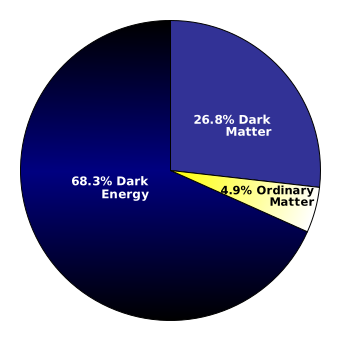
Assuming that the standard model of cosmology is correct, the best current measurements indicate that dark energy contributes 68.3% of the total energy in the present-day observable universe. The mass–energy of dark matter and ordinary (baryonic) matter contribute 26.8% and 4.9%, respectively, and other components such as neutrinos and photons contribute a very small amount.


Estimated distribution of matter and energy in the universe[22]

DMPie_2013.svg


Cosmic microwave background

The existence of dark energy, in whatever form, is needed to reconcile the measured geometry of space with the total amount of matter in the universe. Measurements of cosmic microwave background (CMB) anisotropies indicate that the universe is close to flat. For the shape of the universe to be flat, the mass/energy density of the universe must be equal to the critical density. The total amount of matter in the universe (including baryons and dark matter), as measured from the CMB spectrum, accounts for only about 30% of the critical density. This implies the existence of an additional form of energy to account for the remaining 70%.[19] The Wilkinson Microwave Anisotropy Probe (WMAP) spacecraft seven-year analysis estimated a universe made up of 72.8% dark energy, 22.7% dark matter and 4.5% ordinary matter.[4] Work done in 2013 based on the Planck spacecraft observations of the CMB gave a more accurate estimate of 68.3% of dark energy, 26.8% of dark matter and 4.9% of ordinary matter.[23]
UQ
 
Last edited:
I wish I was smart enough to understand the difference between dark matter and dark energy.
 
I wish I was smart enough to understand the difference between dark matter and dark energy.
Think of dark matter as the magnet, and dark energy as the magnetism, albeit it magnetism in reverse as it's pushing not pulling. Point is you can't see the magnetism, and in the case of dark matter you can't see that either as you would see the magnet.
 
Maybe the boffins have got their sums wrong ? But no-one can disprove their theories other than the result doesn't add up. If our sun burns off millions of tonnes a second then perhaps that where some of it went in 14 billion years ?
 
An important yet-missing link:

The Meaning of Life in a Developing Universe
John Stewart 324
What and that Humans do: Participating in the Meaning of life, a Contributor's Critique
Commentary by Franc Rottiers 341
Analysis of Some Speculations Concerning the Far-Future of Intelligent Civilizations
Commentary by Clément Vidal 344
The Future of Life and What it Means for Humanity
Response by John Stewart 349


Q
http://evodevouniverse.com/wiki/Conference_2008

First International Conference on the

Evolution and Development of the Universe


Wed - Thu, 8 - 9 October 2008, Paris, France

Host Institution: Ecole Normale Supérieure, in collaboration with ECCO, the Evolution, Complexity and Cognition group
and CLEA, the Center Leo Apostelat the Vrije Universiteit Brussel.

Click for a Silhouette Picture, With Attendee Names


Contents

1 Publication content
2 Scientific Committee
3 Submission Options
4 Research Questions and Themes
5 Important Dates
6 Keynote Speakers
7 Program
8 Organizing Committee
9 Venue
10 Fees
11 Lodging and Transport
12 Registration
13 www.regonline.com/EDU2008
14 Contact

Evo Devo Universe is a global scholarly research community exploring and critiquing models, hypotheses, and questions relating to the extent and interaction of evolutionary (or quasi-evolutionary) and developmental (or quasi-developmental) processes in the universe and its subsystems.

EDU 2008 provides an opportunity for those working across these topics to get together and exchange ideas, results and resources. The conference will present and discuss a selection of current work in the field, highlight new directions for investigation and provide small group and open space time for special interest group interaction and collaboration.
Publication content
The full EDU 2008 Special Issue, with commentaries and responses (4mb). Contributions are available for download separately from the table of contents below.


The Evolution and Development of the Universe. 355 pages, Foundations of Science, Special Issue of the Conference on the Evolution and Development of the Universe, Ecole Normale Supérieure, Paris 8-9 Oct., 2008.
Preface 5
List of contributors 7
Introduction, (DOI) 9
Acknowledgements 14


Part I - Physics and Cosmology
Scale Relativity and Fractal Space-Time: Theory and Applications, (DOI)
Laurent Nottale 15
Scale Relativity: an Extended Paradigm for Physics and Biology?
Commentary by Charles Auffray and Denis Noble 80
Multiscale Integration in Scale Relativity Theory
Response by Laurent Nottale 83
The Self-organization of Time and Causality: steps towards understanding the ultimate origin, (DOI)
Francis Heylighen 87
Symmetries and Symmetry-breakings: the fabric of physical interactions and the flow of time
Commentary by Giuseppe Longo 100
Symmetry, Potentiality and Reversibility
Response by Francis Heylighen 102
The Role of Energy Conservation and Vacuum Energy in the Evolution of the Universe, (DOI)
Jan Greben 104
Anthropomorphic Quantum Darwinism as an explanation for Classicality,
Thomas Durt 131
On definitions of Information in Physics
Commentary by Nicolás Lori 154
Competing Definitions of Information versus Entropy in Physics
Response by Thomas Durt 157
Application of Quantum Darwinism to Cosmic Inflation: an example of the limits imposed in Aristotelian logic by information-based approach to Gödel’s incompleteness
Nicolás Lori and Alex Blin 160


Part II – Biology
Towards a Hierarchical Definition of Life, the Organism, and Death
Gerard Jagers op Akkerhuis 169
The Issue of "Closure" in Jagers op Akkerhuis's Operator Theory
Commentary by Nico van Straalen 186
Definitions of Life are not only Unnecessary, but they can do Harm to Understanding
Commentary by Rob Hengeveld 188
Explaining the Origin of Life is not enough for a Definition of Life
Response by Gerard Jagers op Akkerhuis 190
Complexity and Evolution:a study of the growth of complexity in organic and cultural evolution
Börje Ekstig 193
Does Species Evolution Follow Scale Laws ? First Applications of the Scale Relativity Theory to Fossil and Living-beings
Jean Chaline 212


Part III - Philosophy and Big Questions
Development (and Evolution) of the Universe
Stanley Salthe 248
Must Complex Systems Theory Be Materialistic?
Commentary by Horace Fairlamb 260
Friends of Wisdom?
Commentary by Gertrudis Van de Vijver 263
Materialism: Replies to Comments from Readers
Response by Stanley Salthe 266
Possible Implications of the Quantum Theory of Gravity:An Introduction to the Meduso-Anthropic Principle
Louis Crane 269
Two Purposes of Black Hole Production
Commentary by Clément Vidal 274
From Philosophy to Engineering
Response by Louis Crane 277
Computational and Biological Analogies for Understanding Fine-Tuned Parameters in Physics
Clément Vidal 280
On the Nature of Initial Conditions and Fundamental Parameters in Physics and Cosmology
Commentary by Jan Greben 305
Cosmological Artificial Selection: Creation out of something?
Commentary by Rüdiger Vaas 307
Fine-tuning, Quantum Mechanics and Cosmological Artificial Selection
Response by Clément Vidal 310
The Meaning of Life in a Developing Universe
John Stewart 324
What and that Humans do: Participating in the Meaning of life, a Contributor's Critique
Commentary by Franc Rottiers 341
Analysis of Some Speculations Concerning the Far-Future of Intelligent Civilizations
Commentary by Clément Vidal 344
The Future of Life and What it Means for Humanity
Response by John Stewart 349


Scientific Committee

James N. Gardner, complexity theorist with a background in philosophy and theoretical biology. (Portland, OR, USA)

Carlos Gershenson, complexity theorist studying self-organization, evolution, ALife, and cognition. (Boston, MA, USA)

Richard Gordon, embryologist and theoretical biologist exploring development, genetics, and evolution. (Manitoba, Canada)

Francis Heylighen, systems theorist and cyberneticist focusing on the evolution of complexity. (Brussels, Belgium)

David Holcman, mathematician and computational biologist modeling microstructures in biological systems. (Paris, France)

Laurent Nottale, cosmologist and pioneering theorist in scale relativity and fractal space-time. (Paris, France)

John Smart, systems theorist studying accelerating change and evolutionary development. (Mountain View, CA, USA)

Clement Vidal, philosopher and systems theorist studying evolutionary cosmology. (Brussels, Belgium)

Peter Winiwarter, transdisciplinary researcher in complex systems, neural networks and evolution. (Boursay, France)


Submission Options

Extended Abstracts and Papers are the two options for initial submission to the scientific committee, to be considered for conference presentation.
Please use the online submission system to upload your abstract or paper.

Extended Abstracts are 500-1000 words (with brief References, not included in the word count).
Papers are 5000-15000 words, with a brief (100-500 word) Abstract and References (both not included in word count).

You will be notified by August 15th whether your abstract or paper are accepted. If your abstract/paper is accepted, you will have until September 29th to write the paper (abstract accepted) or do any recommended improvements (paper accepted). All those who are accepted are expected to attend the conference to present their papers and to receive in-person feedback. There are no conference fees for presenters, but lodging (a conference hotel is available) and travel costs are your own. Partial lodging dispensation funds may be available for some presenters, please apply only as needed.


Research Questions and Themes

Abstracts and papers considering evolutionary or developmental aspects of the universe and its subsystems are welcome in areas including: cosmology, biology, complexity theory, nonlinear mathematics, information theory, computer science, systems theory, philosophy, culture studies, and related disciplines. Please review Research Questions to understand the scope and focus of research questions in the EDU community. Papers are significantly more likely to be accepted if they clearly address one (or more) of these general questions.

Papers may address any of the following topical Themes, with implications for the universe as a system.

Anthropic bias and observer selection effects.
Anthropic, fine-tuning, and multiverse/ensemble models in cosmology.
Acceleration studies at the universe and subsystem scales.
Astrobiology, Fermi paradox, and SETI.
Complexity, emergence, ergodicity, and nonlinear science models with organic and computational features.
Computational and artificial life inspired models and analogies applied at the universe and subsystem scales.
Cosmology with organic features, such as cosmological natural selection (CNS) and CNS with intelligence (CNS-I).
Directionality, macrodevelopment, and convergent evolution in biological systems.
Evolutionary and developmental processes in evo-devo and theoretical biology.
Evolutionary and developmental processes in non-biological systems (physical, chemical, cultural, technological).
Hierarchy theory, modularity, and self-organization at the universe and subsystem scales.
Information theory of evolution and development, intelligence theory at the universe and subsystem scales.
Network theory and neural networks as a paradigm to explain self-organization of complex networks.
Non-equilibrium dissipative structures at the universe and subsystem scales.
Philosophy and systems theory with organic and computational features at the universe and subsystem scales.
Philosophical and epistemological status of cosmological and speculative theories.
Probability distributions, power laws, and statistical predictability at the universe and subsystem scales.
Scale relativity, scale invariance and self-similarity models at the universe and subsystem scales.
Self-reference, iteration, and recursion models at the universe and subsystem scales.
Systems models relating physical, chemical, biological, cultural, and technological (PCBCT) subsystems

Themes outside the scope of the conference and its community:

Non-naturalistic orthogenesis or teleology, intelligent design, supernaturalism, and theology.

Important Dates

30th July – Deadline for the submission of initial abstracts and paper proposals (extended from 15 July).
15th August – Notification of acceptance (accepted abstracts to be expanded to papers after 15 August)
29th September – Deadline for the receipt of final papers
8-9 October – EDU 2008 Conference, Paris, France.

Keynote Speakers

James N. Gardner, a complexity theorist and science essayist, with a background in philosophy and theoretical biology.
Francis Heylighen, a systems theorist and cyberneticist focusing on the evolution of complexity.
Laurent Nottale, a cosmologist and pioneering theorist in scale relativity and fractal space-time.
John Smart, a systems theorist and scholar of accelerating change.
John Stewart, an evolutionary thinker, author and evolutionary activist.
Clement Vidal, a philosopher and systems theorist studying evolutionary cosmology.

Program

Please see the EDU 2008 Conference Program Page for the detailed daily agenda, and the PDF Program Guide with conference abstracts.

EDU 2008 is two days of presentations and Q&A, panel Q&A, coffee breaks and catered lunch, afternoon special interest groups and open space activities, and optional offsite no-host dinners and after-dinner conversation. List of talks:

An Algorithmic Info Theory Approach to Emergence of Order Using Simple Replication Models, Sean Devine (Abstract|Slides)
Application of Quantum Darwinism to Cosmic Inflation, Nicolas Lori, Alex Blin (Abstract|Slides Private)
Are Particles Self-Organized Systems?, Vladimir Manasson (Abstract|Slides)
Complex-Dynamic Cosmology and Emergent World Structure, Andrei Kirilyuk (Abstract|Slides)
Complexity and Evolution, Börje Ekstig (Abstract|Slides)
Complexity and Energy Density in Big History, Fred Spier (Abstract|Slides)'
Computational and Biological Analogies for Understanding the Fine-Tuning of Parameters in Physics, Clément Vidal (Abstract|Slides)
Does Species Evolution Follow Scale Laws ? An App. of the Scale Relativity Theory to Fossil Living Beings, Jean Chaline (Abstract|Slides Private)
Evo Devo Universe? A Framework for Speculations on Cosmic Culture, John Smart (Abstract|Slides)
Foundations of Physics, Tom Gehrels (Abstract|Slides)
Information Organization and Knowledge Evolution: The Case of Pharmaceutical Innovations, Carl Henning Reschke (Abstract|Not Presented)
Integration as a Fundamental Process in Cosmic Evolution and Science Development, Kris Roose (Abstract|Slides)
Quantum Mechanics and Environment-Induced Superselection Rules, Thomas Durt (Abstract|Slides)
Scale Relativity and Fractal Space-Time: Theory and Applications, Laurent Nottale (Abstract|Audio1(55min)|Slides)
The Meaning of Life in a Developing Universe, John Stewart (Abstract|No Slides)
The Role of Energy Conservation and Vacuum Energy in the Evolution of the Universe, Jan Greben (Abstract|Slides)
The String Landscape as Genetic Alphabet: The Subtle Virtues of a Non-Unique Cosmic Code, James N. Gardner (Abstract|Slides)
Towards a Hierarchical Definition of Life, the Organism, and Death, Gerard Jagers op Akkerhuis (Abstract|Slides Private)
Universal Evolutionary Hierarchy: A Unified Network Approach, Peter Winiwarter (Abstract|Website)

Pre-prints of these papers are available for download in the Files section of EDU-Talk listserve. If you are a scholar interested in these issues, and/or will be a presenter or attendee at EDU 2008, please complete the very brief seven question EDU-Talk Subscription Form to join EDU-Talk and download presenter's papers.
Organizing Committee

Alain Prochiantz (chair), Ecole Normale Supérieure de Paris
Clément Vidal, Vrije Universiteit Brussel
John Smart, Acceleration Studies Foundation
Arnaud Blanchard, Feelix Growing Research Group

Organized in collaboration with the Evolution, Complexity and Cognition group (ECCO) at the Vrije Universiteit Brussel.
UQ

 
I wish I was smart enough to understand the difference between dark matter and dark energy.
To understand it, it helps to look at how they were discovered.

If you look at all the matter in a galaxy, and you measure its rotational spin, you quickly come to the conclusion that there is not enough matter in the galaxy to keep the outer most stars from flying out into space. This is how people came to the conclusion that there must be some extra matter gluing the galaxy together. Since we cannot see it, it cannot be ordinary matter since it does not interact with known particles except gravitationally. From wiki: "..Such arguments are usually based on dimensional analysis and effective field theory. If the universe is described by an effective local quantum field theory down to the Planck scale, then we would expect a cosmological constant of the order of
f214d335d74c0262a3dd5886141b7997.png
. As noted above, the measured cosmological constant is smaller than this by a factor of 10^−120. This discrepancy has been called "the worst theoretical prediction in the history of physics!".[15]"

Dark Energy is far more mysterious and it is seen only on enormous scales. If you look at the red shift of galaxies, you quickly come to the conclusion that the farther a galaxy is from us the faster it is receding. We don't understand what is pushing galaxies apart at this rate and we posit that there is something we don't understand that is happening. Since we are ignorant, we call it dark energy. Very interesting is how Penrose uses the consequences of DE to create cyclic "big bangs". I linked to it here on ET (scroll down): "Seeing through the big bang".

I suggest you explore these two concepts because they are two important candidates for explanations of DE.

  • Cosmological Constant: Dubbed as the 'cost of having space', the cosmological constant, first introduced by Einstein to create a static universe model, and later rejected as a blunder, it is back in vogue again as vacuum energy or the energy contained within vacuum. However, this value turns out to be smaller than what is required to explain the acceleration. It has negative pressure and is used in the Lambda-CDM model to explain expansion.

  • Quintessence: Unlike the cosmological constant, quintessence is a light scalar field that varies through spacetime, incapable of clumping to form matter. It has been modeled in various ways to explain the known properties of dark energy.
 
Last edited:
If we are really able to crate and use stable wormholes, money will be meaningless. Still, it is fun to speculate that the above has implications for HFT. Imagine creating a stable wormhole between the CME and NJ, London/NY, Hong Kong etc, to send electromagnetic data.

The latency would be measured in pico-seconds. :wtf:
 
If you look at all the matter in a galaxy, and you measure its rotational spin, you quickly come to the conclusion that there is not enough matter in the galaxy to keep the outer most stars from flying out into space. This is how people came to the conclusion that there must be some extra matter gluing the galaxy together.

---------------------------------------------------------------------------------------------------

The latest theories say that the Universe is expanding at an increasing rate.
 
http://www.elitetrader.com/et/index...ts-spooky-action-is-real.295386/#post-4198735

Q
Sorry, Einstein. Quantum Study Suggests ‘Spooky Action’ Is Real.
http://www.nytimes.com/2015/10/22/s...riment-said-to-prove-spooky-interactions.html

In a landmark study, scientists at Delft University of Technology in the Netherlands reported that they had conducted an experiment that they say proved one of the most fundamental claims of quantum theory — that objects separated by great distance can instantaneously affect each other’s behavior.

The finding is another blow to one of the bedrock principles of standard physics known as “locality,” which states that an object is directly influenced only by its immediate surroundings. The Delft study, published Wednesday in the journal Nature, lends further credence to an idea that Einstein famously rejected. He said quantum theory necessitated “spooky action at a distance,” and he refused to accept the notion that the universe could behave in such a strange and apparently random fashion.

In particular, Einstein derided the idea that separate particles could be “entangled” so completely that measuring one particle would instantaneously influence the other, regardless of the distance separating them.
UQ


Also check below:

" In Smolin’s terms, quantum mechanics is merely 'a theory of subsystems of the universe'. "
... " What holds true in that thought problem holds true for every object in the real world: the behaviour of each part is inextricably related to that of every other part. If you’ve ever felt as if you wanted to be a part of something big, well, this is the right kind of physics for you. It is also, Smolin thinks, a promising way to obtain bigger answers about how nature really works, across all scales. "

... " By pushing at the bounds of understanding, Hogan and Smolin are helping the field of physics make that connection. They are nudging it toward reconciliation not just between quantum mechanics and general relativity, but between idea and perception. The next great theory of physics will undoubtedly lead to beautiful new mathematics and unimaginable new technologies. But the best thing it can do is create deeper meaning that connects back to us, the observers, who get to define ourselves as the fundamental scale of the universe. "


Q Relativity versus quantum mechanics: the battle for the universe

Physicists have spent decades trying to reconcile two very different theories. But is a winner about to emerge – and transform our understanding of everything from "Time" to "Gravity"?


http://www.theguardian.com/news/2015/nov/04/relativity-quantum-mechanics-universe-physicists

It is the biggest of problems, it is the smallest of problems. At present physicists have two separate rulebooks explaining how nature works. There is general relativity, which beautifully accounts for gravity and all of the things it dominates: orbiting planets, colliding galaxies, the dynamics of the expanding universe as a whole. That’s big. Then there is quantum mechanics, which handles the other three forces – electromagnetism and the two nuclear forces. Quantum theory is extremely adept at describing what happens when a uranium atom decays, or when individual particles of light hit a solar cell. That’s small.

Now for the problem: relativity and quantum mechanics are fundamentally different theories that have different formulations. It is not just a matter of scientific terminology; it is a clash of genuinely incompatible descriptions of reality.

The conflict between the two halves of physics has been brewing for more than a century – sparked by a pair of 1905 papers by Einstein, one outlining relativity and the other introducing the quantum – but recently it has entered an intriguing, unpredictable new phase. Two notable physicists have staked out extreme positions in their camps, conducting experiments that could finally settle which approach is paramount.

Basically you can think of the division between the relativity and quantum systems as “smooth” versus “chunky”. In general relativity, events are continuous and deterministic, meaning that every cause matches up to a specific, local effect. In quantum mechanics, events produced by the interaction of subatomic particles happen in jumps (yes, quantum leaps), with probabilistic rather than definite outcomes. Quantum rules allow connections forbidden by classical physics. This was demonstrated in a much-discussed recent experiment in which Dutch researchers defied the local effect. They showed that two particles – in this case, electrons – could influence each other instantly, even though they were a mile apart. When you try to interpret smooth relativistic laws in a chunky quantum style, or vice versa, things go dreadfully wrong.

Relativity gives nonsensical answers when you try to scale it down to quantum size, eventually descending to infinite values in its description of gravity. Likewise, quantum mechanics runs into serious trouble when you blow it up to cosmic dimensions. Quantum fields carry a certain amount of energy, even in seemingly empty space, and the amount of energy gets bigger as the fields get bigger. According to Einstein, energy and mass are equivalent (that’s the message of E=mc2), so piling up energy is exactly like piling up mass. Go big enough, and the amount of energy in the quantum fields becomes so great that it creates a black hole that causes the universe to fold in on itself. Oops.

Craig Hogan, a theoretical astrophysicist at the University of Chicago and the director of the Center for Particle Astrophysics at Fermilab, is reinterpreting the quantum side with a novel theory in which the quantum units of space itself might be large enough to be studied directly. Meanwhile, Lee Smolin, a founding member of the Perimeter Institute for Theoretical Physics in Waterloo, Canada, is seeking to push physics forward by returning to Einstein’s philosophical roots and extending them in an exciting direction.

To understand what is at stake, look back at the precedents. When Einstein unveiled general relativity, he not only superseded Isaac Newton’s theory of gravity; he also unleashed a new way of looking at physics that led to the modern conception of the Big Bang and black holes, not to mention atomic bombs and the time adjustments essential to your phone’s GPS. Likewise, quantum mechanics did much more than reformulate James Clerk Maxwell’s textbook equations of electricity, magnetism and light. It provided the conceptual tools for the Large Hadron Collider, solar cells, all of modern microelectronics.

What emerges from the dust-up could be nothing less than a third revolution in modern physics, with staggering implications. It could tell us where the laws of nature came from, and whether the cosmos is built on uncertainty or whether it is fundamentally deterministic, with every event linked definitively to a cause.

Small is beautiful

Hogan, champion of the quantum view, is what you might call a lamp-post physicist: rather than groping about in the dark, he prefers to focus his efforts where the light is bright, because that’s where you are most likely to be able to see something interesting. That’s the guiding principle behind his current research. The clash between relativity and quantum mechanics happens when you try to analyse what gravity is doing over extremely short distances, he notes, so he has decided to get a really good look at what is happening right there. “I’m betting there’s an experiment we can do that might be able to see something about what’s going on, about that interface that we still don’t understand,” he says.

A basic assumption in Einstein’s physics – an assumption going all the way back to Aristotle, really – is that space is continuous and infinitely divisible, so that any distance could be chopped up into even smaller distances. But Hogan questions whether that is really true. Just as a pixel is the smallest unit of an image on your screen and a photon is the smallest unit of light, he argues, so there might be an unbreakable smallest unit of distance: a quantum of space.

Chunky space does not neatly align with the ideas in string theory – or in any other proposed physics model

In Hogan’s scenario, it would be meaningless to ask how gravity behaves at distances smaller than a single chunk of space. There would be no way for gravity to function at the smallest scales because no such scale would exist. Or put another way, general relativity would be forced to make peace with quantum physics, because the space in which physicists measure the effects of relativity would itself be divided into unbreakable quantum units. The theatre of reality in which gravity acts would take place on a quantum stage.

Hogan acknowledges that his concept sounds a bit odd, even to a lot of his colleagues on the quantum side of things. Since the late 1960s, a group of physicists and mathematicians have been developing a framework called string theory to help reconcile general relativity with quantum mechanics; over the years, it has evolved into the default mainstream theory, even as it has failed to deliver on much of its early promise. Like the chunky-space solution, string theory assumes a fundamental structure to space, but from there the two diverge. String theory posits that every object in the universe consists of vibrating strings of energy. Like chunky space, string theory averts gravitational catastrophe by introducing a finite, smallest scale to the universe, although the unit strings are drastically smaller even than the spatial structures Hogan is trying to find.

Chunky space does not neatly align with the ideas in string theory – or in any other proposed physics model, for that matter. “It’s a new idea. It’s not in the textbooks; it’s not a prediction of any standard theory,” Hogan says, sounding not the least bit concerned. “But there isn’t any standard theory, right?”

If he is right about the chunkiness of space, that would knock out a lot of the current formulations of string theory and inspire a fresh approach to reformulating general relativity in quantum terms. It would suggest new ways to understand the inherent nature of space and time. And weirdest of all, perhaps, it would bolster the notion that our seemingly three-dimensional reality is composed of more basic, two-dimensional units. Hogan takes the “pixel” metaphor seriously: just as a TV picture can create the impression of depth from a bunch of flat pixels, he suggests, so space itself might emerge from a collection of elements that act as if they inhabit only two dimensions.

Like many ideas from the far edge of today’s theoretical physics, Hogan’s speculations can sound suspiciously like late-night philosophising in the freshman dorm. What makes them drastically different is that he plans to put them to a hard experimental test. As in, right now.

A living thing in two places at once? This quantum quandary test is limited

Starting in 2007, Hogan began thinking about how to build a device that could measure the exceedingly fine graininess of space. As it turns out, his colleagues had plenty of ideas about how to do that, drawing on technology developed to search for gravitational waves. Within two years Hogan had put together a proposal and was working with collaborators at Fermilab, the University of Chicago and other institutions to build a chunk-detecting machine, which he more elegantly calls a “holometer”. (The name is an esoteric pun, referencing both a 17th-century surveying instrument and the theory that 2D space could appear three-dimensional, analogous to a hologram.)

Beneath its layers of conceptual complexity, the holometer is technologically little more than a laser beam, a half-reflective mirror to split the laser into two perpendicular beams, and two other mirrors to bounce those beams back along a pair of 40m-long tunnels. The beams are calibrated to register the precise locations of the mirrors. If space is chunky, the locations of the mirrors would constantly wander about (strictly speaking, space itself is doing the wandering), creating a constant, random variation in their separation. When the two beams are recombined, they’d be slightly out of sync, and the amount of the discrepancy would reveal the scale of the chunks of space.

For the scale of chunkiness that Hogan hopes to find, he needs to measure distances to an accuracy of 10-18m, about 100m times smaller than a hydrogen atom, and collect data at a rate of about 100m readings per second. Amazingly, such an experiment is not only possible, but practical. “We were able to do it pretty cheaply because of advances in photonics, a lot of off-the-shelf parts, fast electronics and things like that,” Hogan says. “It’s a pretty speculative experiment, so you wouldn’t have done it unless it was cheap.” The holometer is currently humming away, collecting data at the target accuracy; he expects to have preliminary readings by the end of the year.

Hogan has his share of fierce sceptics, including many within the theoretical physics community. The reason for the disagreement is easy to appreciate: a success for the holometer would mean failure for a lot of the work being done in string theory. Despite this superficial sparring, though, Hogan and most of his theorist colleagues share a deep core conviction: they broadly agree that general relativity will ultimately prove subordinate to quantum mechanics. The other three laws of physics follow quantum rules, so it makes sense that gravity must as well.

For most of today’s theorists, however, belief in the primacy of quantum mechanics runs deeper still. At a philosophical – epistemological – level, they regard the large-scale reality of classical physics as a kind of illusion, an approximation that emerges from the more “true” aspects of the quantum world operating at an extremely small scale. Chunky space certainly aligns with that worldview.

Hogan likens his project to the landmark Michelson-Morley experiment of the 19th century, which searched for the aether – the hypothetical substance of space that, according to the leading theory of the time, transmitted light waves through a vacuum. The experiment found nothing; that perplexing null result helped inspire Einstein’s special theory of relativity, which in turn spawned the general theory of relativity and eventually turned the entire world of physics upside down. Adding to the historical connection, the Michelson-Morley experiment also measured the structure of space using mirrors and a split beam of light, following a setup remarkably similar to Hogan’s.

“We’re doing the holometer in that kind of spirit. If we don’t see something or we do see something, either way it’s interesting. The reason to do the experiment is just to see whether we can find something to guide the theory,” Hogan says. “You find out what your theorist colleagues are made of by how they react to this idea. There’s a world of very mathematical thinking out there. I’m hoping for an experimental result that forces people to focus the theoretical thinking in a different direction.”

Whether or not he finds his quantum structure of space, Hogan is confident the holometer will help physics address its big-small problem. It will show the right way (or rule out the wrong way) to understand the underlying quantum structure of space and how that affects the relativistic laws of gravity flowing through it.


A bigger vision

If you are looking for a totally different direction, Smolin of the Perimeter Institute is your man. Where Hogan goes gently against the grain, Smolin is a full-on dissenter: “There’s a thing that Richard Feynman told me when I was a graduate student. He said, approximately, ‘If all your colleagues have tried to demonstrate that something’s true and failed, it might be because that thing is not true.’ Well, string theory has been going for 40 or 50 years without definitive progress.”

And that is just the start of a broader critique. Smolin thinks the small-scale approach to physics is inherently incomplete. Current versions of quantum field theory do a fine job explaining how individual particles or small systems of particles behave, but they fail to take into account what is needed to have a sensible theory of the cosmos as a whole. They don’t explain why reality is like this, and not like something else. In Smolin’s terms, quantum mechanics is merely “a theory of subsystems of the universe”.

A more fruitful path forward, he suggests, is to consider the universe as a single enormous system, and to build a new kind of theory that can apply to the whole thing. And we already have a theory that provides a framework for that approach: general relativity. Unlike the quantum framework, general relativity allows no place for an outside observer or external clock, because there is no “outside”. Instead, all of reality is described in terms of relationships between objects and between different regions of space. Even something as basic as inertia (the resistance of your car to move until forced to by the engine, and its tendency to keep moving after you take your foot off the accelerator) can be thought of as connected to the gravitational field of every other particle in the universe.

That last statement is strange enough that it’s worth pausing for a moment to consider it more closely. Consider a thought problem, closely related to the one that originally led Einstein to this idea in 1907. What if the universe were entirely empty except for two astronauts? One of them is spinning, the other is stationary. The spinning one feels dizzy, doing cartwheels in space. But which one of the two is spinning? From either astronaut’s perspective, the other is the one spinning. Without any external reference, Einstein argued, there is no way to say which one is correct, and no reason why one should feel an effect different from what the other experiences.

The distinction between the two astronauts makes sense only when you reintroduce the rest of the universe. In the classic interpretation of general relativity, then, inertia exists only because you can measure it against the entire cosmic gravitational field. What holds true in that thought problem holds true for every object in the real world: the behaviour of each part is inextricably related to that of every other part. If you’ve ever felt as if you wanted to be a part of something big, well, this is the right kind of physics for you. It is also, Smolin thinks, a promising way to obtain bigger answers about how nature really works, across all scales.

“General relativity is not a description of subsystems. It is a description of the whole universe as a closed system,” he says. When physicists are trying to resolve the clash between relativity and quantum mechanics, therefore, it seems like a smart strategy for them to follow Einstein’s lead and go as big as they possibly can.

Smolin is keenly aware that he is pushing against the prevailing devotion to small-scale, quantum-style thinking. “I don’t mean to stir things up; it just kind of happens that way. My role is to think clearly about these difficult issues, put my conclusions out there, and let the dust settle,” he says genially. “I hope people will engage with the arguments, but I really hope that the arguments lead to testable predictions.”

At first blush, Smolin’s ideas sound like a formidable starting point for concrete experimentation. Much as all of the parts of the universe are linked across space, they may also be linked across time, he suggests. His arguments led him to hypothesise that the laws of physics evolve over the history of the universe. Over the years, he has developed two detailed proposals for how this might happen. His theory of cosmological natural selection, which he hammered out in the 1990s, envisions black holes as cosmic eggs that hatch new universes. More recently, he has developed a provocative hypothesis about the emergence of the laws of quantum mechanics, called the principle of precedence – and this one seems much more readily put to the test.

Smolin’s principle of precedence arises as an answer to the question of why physical phenomena are reproducible. If you perform an experiment that has been performed before, you expect the outcome will be the same as in the past. (Strike a match and it bursts into flame; strike another match the same way and… you get the idea.) Reproducibility is such a familiar part of life that we typically don’t even think about it. We simply attribute consistent outcomes to the action of a natural “law” that acts the same way at all times. Smolin hypothesises that those laws actually may emerge over time, as quantum systems copy the behaviour of similar systems in the past.

One possible way to catch emergence in the act is by running an experiment that has never been done before, so there is no past version (that is, no precedent) for it to copy. Such an experiment might involve the creation of a highly complex quantum system, containing many components that exist in a novel entangled state. If the principle of precedence is correct, the initial response of the system will be essentially random. As the experiment is repeated, however, precedence builds up and the response should become predictable… in theory. “A system by which the universe is building up precedent would be hard to distinguish from the noises of experimental practice,” Smolin concedes, “but it’s not impossible.”

Although precedence can play out at the atomic scale, its influence would be system-wide, cosmic. It ties back to Smolin’s idea that small-scale, reductionist thinking seems like the wrong way to solve the big puzzles. Getting the two classes of physics theories to work together, though important, is not enough, either. What he wants to know – what we all want to know – is why the universe is the way it is. Why does time move forward and not backward? How did we end up here, with these laws and this universe, not some others?

The present lack of any meaningful answer to those questions reveals “something deeply wrong with our understanding of quantum field theory”, Smolin says. Like Hogan, he is less concerned about the outcome of any one experiment than he is with the larger programme of seeking fundamental truths. For Smolin, that means being able to tell a complete, coherent story about the universe; it means being able to predict experiments, but also to explain the unique properties that made atoms, planets, rainbows and people. Here again he draws inspiration from Einstein.

“The lesson of general relativity, again and again, is the triumph of relationalism,” Smolin says. The most likely way to get the big answers is to engage with the universe as a whole.

And the winner is?

If you wanted to pick a referee in the big-small debate, you could hardly do better than Sean Carroll, an expert in cosmology, field theory and gravitational physics at Caltech. He knows his way around relativity, he knows his way around quantum mechanics, and he has a healthy sense of the absurd: he calls his personal blog Preposterous Universe. Right off the bat, Carroll awards most of the points to the quantum side. “Most of us in this game believe that quantum mechanics is much more fundamental than general relativity is,” he says. That has been the prevailing view ever since the 1920s, when Einstein tried and repeatedly failed to find flaws in the counterintuitive predictions of quantum theory. The recent Dutch experiment demonstrating an instantaneous quantum connection between two widely separated particles – the kind of event that Einstein derided as “spooky action at a distance” – only underscores the strength of the evidence.

Taking a larger view, the real issue is not general relativity versus quantum field theory, Carroll explains, but classical dynamics versus quantum dynamics. Relativity, despite its perceived strangeness, is classical in how it regards cause and effect; quantum mechanics most definitely is not. Einstein was optimistic that some deeper discoveries would uncover a classical, deterministic reality hiding beneath quantum mechanics, but no such order has yet been found. The demonstrated reality of spooky action at a distance argues that such order does not exist.

“If anything, people underappreciate the extent to which quantum mechanics just completely throws away our notions of space and locality [the notion that a physical event can affect only its immediate surroundings]. Those things simply are not there in quantum mechanics,” Carroll says. They may be large-scale impressions that emerge from very different small-scale phenomena, like Hogan’s argument about 3D reality emerging from 2D quantum units of space.

Despite that seeming endorsement, Carroll regards Hogan’s holometer as a long shot, though he admits it is removed from his area of research. At the other end, he doesn’t think much of Smolin’s efforts to start with space as a fundamental thing; he believes the notion is as absurd as trying to argue that air is more fundamental than atoms. As for what kind of quantum system might take physics to the next level, Carroll remains broadly optimistic about string theory, which he says “seems to be a very natural extension of quantum field theory”. In all these ways, he is true to the mainstream, quantum-based thinking in modern physics.

Yet Carroll’s ruling, while almost entirely pro-quantum, is not purely an endorsement of small-scale thinking. There are still huge gaps in what quantum theory can explain. “Our inability to figure out the correct version of quantum mechanics is embarrassing,” he says. “And our current way of thinking about quantum mechanics is simply a complete failure when you try to think about cosmology or the whole universe. We don’t even know what time is.” Both Hogan and Smolin endorse this sentiment, although they disagree about what to do in response. Carroll favours a bottom-up explanation in which time emerges from small-scale quantum interactions, but declares himself “entirely agnostic” about Smolin’s competing suggestion that time is more universal and fundamental. In the case of time, then, the jury is still out.

No matter how the theories shake out, the large scale is inescapably important, because it is the world we inhabit and observe. In essence, the universe as a whole is the answer, and the challenge to physicists is to find ways to make it pop out of their equations. Even if Hogan is right, his space-chunks have to average out to the smooth reality we experience every day. Even if Smolin is wrong, there is an entire cosmos out there with unique properties that need to be explained – something that, for now at least, quantum physics alone cannot do.

By pushing at the bounds of understanding, Hogan and Smolin are helping the field of physics make that connection. They are nudging it toward reconciliation not just between quantum mechanics and general relativity, but between idea and perception. The next great theory of physics will undoubtedly lead to beautiful new mathematics and unimaginable new technologies. But the best thing it can do is create deeper meaning that connects back to us, the observers, who get to define ourselves as the fundamental scale of the universe.

• This essay originally appeared in issue 29 of Nautilus. To find out more, visit nautil.us http://nautil.us/

UQ
 
Back
Top