A 2-3% Correction Could Wipe Out Most VIX Short Sellers

So it all comes down to managing your risk, sizing your positions, hedging your tail risk and so on.


There is one point that makes sense to me out of all this that inverse etfs are at higher risk of liquidation since an 100% intra-day spike is easier to happen when vix is 9 then when its 15-20. But if you read what their own note says, a 12 point vix spike will translate into 50% futures move, so its not going to be enough to trigger liquidation. So realistically we are talking about higher then 12 point spike something like 20 point spike in vix to get us there. Its a pretty unlikely event, but even if it does happen it only affects inverse etfs, specifically SVXY so that $1B or ~100K vix contracts that will be bought in front 2 month. It is a sizable position, but is it really going to cause market to melt down? The long vol etfs won't trigger anything on futures market.

Here is volume/OI on Nov future on oct 19: 154K volume/372K OI.

here is what SVXY is holding: Short 14K nov, short 79k dec.

As I said, potentially an exciting day, maybe a week, thats it, nothing crazy

All Morgan Stanley note said is this: since vix is low, risks of a one day event that can turn nasty have slightly increased since its easier to get that intra-day 100% spike when vix is at 9, thats all, also pointed to increased retail vol shorts and etf factor, just pointed those things out, also don't forget we had North Korea situation taking place, so a fair warning nothing more.

 

John Mauldin


Growth, macro, healthcare
Thoughts from the Frontline
(10,226 followers)
Summary


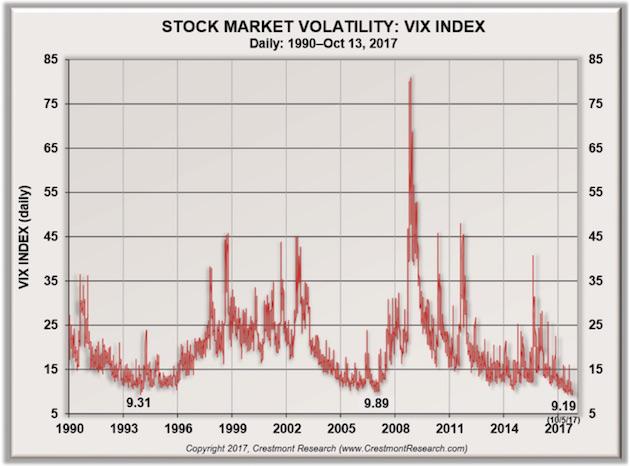
Did you know that there have been 39 times since 1990 when the VIX has closed below 10, and that 30 of those times have happened this year?

And 15 of those have been in the last 30 days!

A 2% or 3% move down in the markets could cause short covering in the VIX that could quickly spiral out of control.

Did you know that there have been 39 times since 1990 when the VIX has closed below 10, and that 30 of those times have happened this year? And 15 of those have been in the last 30 days!

Ed Easterling of Crestmont Research sent me recently an updated chart of the VIX Index. Notice that the all-time low of 9.19 was put in on October 5, 2017.

saupload_171016_OP_Correction_image1.jpg


All the previous sub-10 closes occurred in only two periods: Four of them were in the winter of 1993–1994 (around Christmas, which is traditionally a light trading period), and the others were in the winter of 2006–2007, another period of great complacency.

You can’t really draw any conclusions about the next move of the markets (I’ve written a lot about the unpredictability of the market in my free weekly newsletter, Thoughts from the Fronline, lately), because the VIX could spike to 50 or stay in this low range for a very long time.

There’s Massive Short Position in VIX
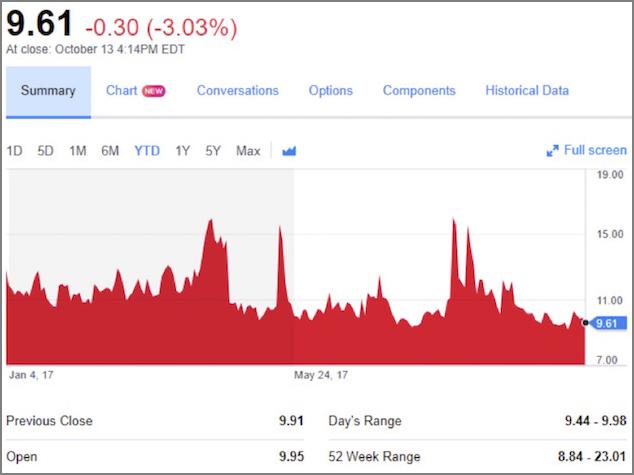
Essentially, we have trained investors to “buy the dips,” and that mentality removes a lot of volatility. Here is a chart of the VIX since the beginning of the year (from Yahoo Finance):

saupload_171016_OP_Correction_image2gray.jpg


I got a blitz email tutorial this week from my friend Doug Kass (of Seabreeze Capital), a writer for the Street.com and Real Money Pro. He generally puts out two to three short pieces a day with his observations on the markets, and he discusses what stocks he is trading.

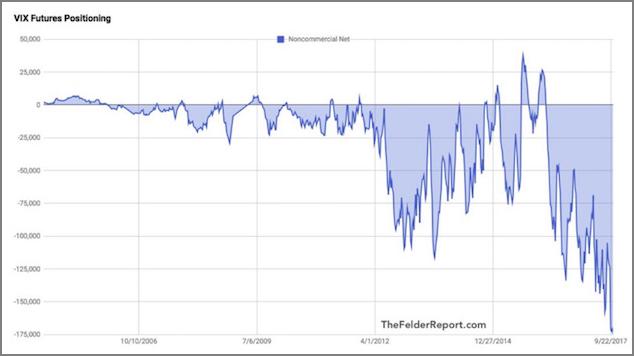
I was particularly struck with his observation about the massive—and it truly ismassive—short position in the VIX and VIX futures. Look at this chart:

saupload_171016_OP_Correction_image3gray.jpg


Now, as my friend and fellow Mauldin Economics writer Jared Dillian notes, prior to 2006, it was not possible for retail investors to trade the VIX, so an ETF was created and options and futures became available.

Prior to that time it was just professionals who could create the effect of the VIX with futures and options trade positioning on the S&P. You almost had to be a pit trader to be able to do it.

A 2-3% Correction in the Markets Is All That It Takes
Understand, the VIX is a totally artificial construct. It’s a way to measure the future expectations of investors regarding the volatility of market prices. And lately, investors have been rewarded for shorting the VIX.

It is almost like the experiments you see where rats learn that if they punch a button, they get a grape. Investors have learned that if they short the VIX, they make a profit.

Except that now there are so many people on that side of the boat that when the boat starts to turn over, the rush to get the other side is going to rock that boat hard… possibly to the point of swamping it.

Doug warns that a 2% or 3% move down in the markets could cause short covering in the VIX that could quickly spiral out of control. Not unlike the “portfolio protection” trade that brought about the 1987 crash.

Disclosure: I/we have no positions in any stocks mentioned, and no plans to initiate any positions within the next 72 hours.


I wrote this article myself, and it expresses my own opinions. I am not receiving compensation for it. I have no business relationship with any company whose stock is mentioned in this article.
Should I go long VIX? I am very tempted to do just that.
 
I can’t imagine there being a true contagion risk due to vol sellers, simply because none of them are systemically important. Even with the contribution of short gamma from all outstanding short RP, it’s not like it’s going to take S&P down 10%.

Blow up will happen sooner or later. That’s a good thing. We might see a bunch of risk premium providers get blown up and be out permanently, a lot of people will get burned and stay away for a while. Maybe it’s not going to be due to a single “bad day” or even a week, we might need a few months of nastiness. Or, if we see a few successive 3+ sigma down days, it will be over quick.

It’s certainly easier to blow up at these levels than when vol was at mid-teens, which will contribute to the story but not meaningfully.
 
I can’t imagine there being a true contagion risk due to vol sellers, simply because none of them are systemically important. Even with the contribution of short gamma from all outstanding short RP, it’s not like it’s going to take S&P down 10%.

Blow up will happen sooner or later. That’s a good thing. We might see a bunch of risk premium providers get blown up and be out permanently, a lot of people will get burned and stay away for a while. Maybe it’s not going to be due to a single “bad day” or even a week, we might need a few months of nastiness. Or, if we see a few successive 3+ sigma down days, it will be over quick.

It’s certainly easier to blow up at these levels than when vol was at mid-teens, which will contribute to the story but not meaningfully.

ATM Vol at 7 is indicative of other risk premia. And combined that can take the market down 10-15percent.
 
I'm sure there are ways to monitor the VXX and compare that to to a basket of VX futures and make money over short periods of time. It would require being faster and know more than larger players that have the live data to know what the VXX is worth every second that also get cross margining that you won't. Not really practical for a retail account.

It wouldn't require being faster than larger players.

Here's a practical retail example:

http://jonathankinlay.com/2016/07/developing-volatility-carry-strategy/
 
That's not what Bob is talking about. He was describing arbing the ETFs against the futures. Forget about that as I'm sure it's locked down.

As far as that link goes it's just a spread trade that varies over time. If you want to trade the curve trade the spreads directly on CFE.

Yeah sure, but Bob was responding to my comment about 'Long VX futures short VXX; suggeting that a high fequency arb strategy was the only way to stuture the trade.

But It wouldn't be the same as trading the curve. VXX suffers some kind of time decay( not just from contango)
 
Last edited:
It wouldn't require being faster than larger players.
Two things are not clear to me here (Maybe because I just woke up :D):

  • What does the actual portfolio look like?
  • When do you enter and exit?
  • Are the results from real trading?
  • What do you do if the VIX were to spike 25%, 50%, 100%?
  • How would the account owner deal with margin requirements during large VX up moves as there is no cross margining?
  • Is the cost of shoring ETFs/ETNs included?
 
Seems lunacy to be selling vol now. What makes sense is to buy some way OTM SPX puts to hedge a diversified passive portfolio
 
But It wouldn't be the same as trading the curve. VXX suffers some kind of time decay( not just from contango)
It would be identical to trading the curve and VXX time decay is exactly from contango, just in a different form.
 
Back
Top