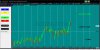
@ironchef here are my thoughts on trends
Traders are different when it comes to deciding how/why/where/when to enter trades, manage their trades and how/why/where/when to exit trades. However, once in a trade, they all expect price to trend in the trade direction for some time period and believe that they can profitably trade some portion of that trend.
Trends can be defined by the following:
- A trend is a price action pattern that repeats over and over again
- Trends can be found in any timeframe and on any chart type
- Trends can be defined as price movement in one direction
Trends can be defined and measured by the initial stoploss
- A new trend starts when an existing trend has price action that reverses more than the initial stoploss
- A trend ends when price pulls back by more than the initial stoploss
- Trend lengths can be measured by using increments of the 1R initial stoploss
Markets and trends change over time, so an initial stoploss should be adjusted to reflect changing trends. I use computer code to analyze the relationship between initial stoploss and trends, looking for the best initial stoploss/trend combination. i used to spend all weekend doing this manually. The attached gold chart is an example of the information I get from my analysis from top to bottom on the right side of the chart.
- The look back is 10 trading days
- Trends are derived from the initial stoploss using the above definitions and measurements.
- Shown in green, on average between 5am pst and 7am pst, there are on average, 5 total trends each day. 51% of those trends are >=2R and 26% of these trends are >=3R.
- Next in black, those 51% of trends average 3.0R to 3.6R in length
- Last the average trend time is 12 minutes
Given the above information from my analysis, this is what I believe:
- There is a new trend only after the trend moves 1R in the new trend direction, so I give up 1R profits before any possible trade entry
- There is a 51% chance of the trend being >=2R and a 26% of the trend being >=3R
- If I enter within 2R of the trend starting point, there is on average, 1-2R left in the trend.
- The initial stoploss is 1R, the profit target is 2R and the plan is to enter within 2R and exit before 4R
- My trade management system will use these factors to keep losses <=1R, protect profits as they accumulate and exit at 2R.
- No matter what I noted above, all price action is random and anything can happen. For example, if I flip a coin 10,000 times and 10,000 times the coin comes up heads, the next flip probability is 50:50. So trade management is critical to successful trading.


 But that's silly, considering that you can't cherry pick while trading live. Bottom fishing, namely thinking it's the start of a new trend, is not a low risk entry. Most will get stopped out. That's why you often see double bottoms (or triple bottoms, or straight up range bound market).