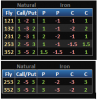
Okay, I see. How does this labelling now help us trade better?
By dissecting the position into components with different sensitivities to say Delta / Vega
By prioritising risk / opportunity if you have or change your view on market direction / vols

Okay, I see. How does this labelling now help us trade better?
And I'm still confused as to what is synthetic here?
Jamesbp, I have a question for you - where is the synthetic in all of the theoretical positions you mentioned?Another example ... say you are short a 3200-3300 Guts strangle ... short 3200c - short 3300p
Guts strangle trading for 105
You have a policy of not holding short strangles when premium less than 10
Do you hold or close the strangle / why ?
Jamesbp, I have a question for you - where is the synthetic in all of the theoretical positions you mentioned?
OC,you are scrambling
You keep on bringing up IV and Flys and are off on your assumption
Not all Flys go up when IV decreases.
If you buy an far OTM fly,it will be cheaper if IV is lower.
Doesnt make sense to add direction/delta to the equation to support your IV argument.
Are you also saying that an ATM fly is not a directional bet?
Why not look at all BFLY's deltahedged(flat) and isolate the IV component?
I do agree that some Flys are way more sensitive to vol than others,but that doesnt make your statement accurate.
Im not making it up.Just look at an option calculator.Plug and play
You keep confusing everything I am saying.
You made a simple statement that an OTM FLY needs IV to go up.
I showed you an example where that is not true.
An OTM Call FLY will earn if the underlying moves higher and time passes and IV stays the same or even goes down a little. if I can show one example where a statement is wrong than it is not necessarily true.
I'm not making it up, just look at an option tool.
If you are long a far OTM fly,you need high vol for the stock to have any chance of getting to your long strikes..
Inserted below is the table Doobs created. Nice visual!