
You are using an out of date browser. It may not display this or other websites correctly.
You should upgrade or use an alternative browser.
You should upgrade or use an alternative browser.
2014 was a summer sizzler: Earth's hottest on record
- Thread starter futurecurrents
- Start date

1. Go ahead... for once provide substance and not leftist crap.
Show us that man made co2 is causing warming in our environment. or, I will make it easy....
For starters... Show us that if you include data to 2014 we are warming outside natural variability.
2. And finally nice bit of projection..
I am the one open minded to science. I freely state I do not know if man made co2 is warming, cooling or doing nothing.
I am just asking for good data showing we are warming outside natural vairiablity... and then evidence man made co2 is not causing warming.
All the recent studies show the sun and the tides are having the impact.
I see no studies coming out and showing its made made co2.
Do you have any science showing its mand made co2 at all?
After 1500 posts, you want more?
"hottest summer on record!", or whatever -- was it just in the U.S. or world wide?, and whose record and how long is that record I wonder. Something on the order of one ten millionth of the Earths history, I suppose.. We have of course proxy records for temperature going back a very long way. They are very unreliable and inaccurate yet they are not so unreliable and inaccurate for us to be certain that today's temperature variation lies well within the the natural variation of Earth's temperatures. Ninety percent of the species that ever lived are extinct and man had nothing to do with it, and so far it certainly looks like man has nothing to do with climate change either. The hottest summer on record! Don't make me laugh. Let's wait and see what the winter is like --maybe it will be the coldest on record, who knows? Then let's wait another century and see what the temperature does. By then we aught to have at least a rudimentary understanding of our planet's climate.
Current climate models predict greater increases in temperature than we have actually experienced. They do this by assuming (yes, it's a guess based on an hypothesis) slight additional warming from a few additional CO2 molecules per volume gets amplified by water vapor and clouds (water is the primary green house gas, CO2 the minor one) to increase CO2's effect -- positive feedback, in other words. Unfortunately we still don't know whether the effect of clouds is net warming or cooling. So this assumption of the models is tenuous. (The IPCC, in its reports, has acknowledged that clouds are a large source of uncertainty in climate models.)
Furthermore, the phase relationship between observed changes in temperature and CO2 concentration is inconsistent with these positive feedback models. There are detectable increases in temperature leading by many months increases in CO2, then as CO2 increases, temperature drops. It's cyclical, depending on what time esolution one uses to look at the data. The models do not correctly predict the observed phase relationship. It is as though anthro-CO2, which also varies somewhat on a short time scale, is a mere bystander to a larger naturally occurring variation in CO2, with the variation riding on slowly increasing, long-time-scale CO2. This will eventually get sorted out, because if CO2 concentration is dominated by natural events, temperature excursions being only one of them, then, if we wait long enough, we can expect to see an overall drop in CO2 against an anthro-CO2 emission that does not drop. This would be consistent with what we now know about the magnitudes of natural CO2 sourcing and sinking compared with the much smaller magnitude of anthro-CO2 emissions.
So far, any temperature anomaly attributed to CO2 is undetectable against a background of natural temperature variability. This is the primary dilemma faced by those seeking a relationship between CO2 concentration and temperature via models. All predictions of higher temperatures caused by anthro-CO2 emissions are based on models. Unfortunately, no model has yet been shown to be reliable. One has no choice, therefore, other than to conclude that predictions of catastrophic temperature excursions driven by anthro-CO2 emissions are also unreliable.
The opportunity for bad science here is staggering! And politics has made it nearly impossible for the good science to win out. But it eventually will. It always does.
Current climate models predict greater increases in temperature than we have actually experienced. They do this by assuming (yes, it's a guess based on an hypothesis) slight additional warming from a few additional CO2 molecules per volume gets amplified by water vapor and clouds (water is the primary green house gas, CO2 the minor one) to increase CO2's effect -- positive feedback, in other words. Unfortunately we still don't know whether the effect of clouds is net warming or cooling. So this assumption of the models is tenuous. (The IPCC, in its reports, has acknowledged that clouds are a large source of uncertainty in climate models.)
Furthermore, the phase relationship between observed changes in temperature and CO2 concentration is inconsistent with these positive feedback models. There are detectable increases in temperature leading by many months increases in CO2, then as CO2 increases, temperature drops. It's cyclical, depending on what time esolution one uses to look at the data. The models do not correctly predict the observed phase relationship. It is as though anthro-CO2, which also varies somewhat on a short time scale, is a mere bystander to a larger naturally occurring variation in CO2, with the variation riding on slowly increasing, long-time-scale CO2. This will eventually get sorted out, because if CO2 concentration is dominated by natural events, temperature excursions being only one of them, then, if we wait long enough, we can expect to see an overall drop in CO2 against an anthro-CO2 emission that does not drop. This would be consistent with what we now know about the magnitudes of natural CO2 sourcing and sinking compared with the much smaller magnitude of anthro-CO2 emissions.
So far, any temperature anomaly attributed to CO2 is undetectable against a background of natural temperature variability. This is the primary dilemma faced by those seeking a relationship between CO2 concentration and temperature via models. All predictions of higher temperatures caused by anthro-CO2 emissions are based on models. Unfortunately, no model has yet been shown to be reliable. One has no choice, therefore, other than to conclude that predictions of catastrophic temperature excursions driven by anthro-CO2 emissions are also unreliable.
The opportunity for bad science here is staggering! And politics has made it nearly impossible for the good science to win out. But it eventually will. It always does.
Last edited:
You're not keeping up."hottest summer on record!", or whatever -- was it just in the U.S. or world wide?,
http://www.weather.com/news/science/environment/august-2014-hottest-history-20140915
You're not keeping up.
http://www.weather.com/news/science/environment/august-2014-hottest-history-20140915
Ha ha I know. It's like piehole did not even see this. And then he just mindlessly babbled on in an impressive display of bovine feces creation. He's literally unbelievable. LOL He probably cracks himself up as he writes the shit.
I'll put this here for him so maybe he sees it this time.
From the article...
"Data released by NASA's Goddard Institute for Space Studies on Monday shows that August 2014 was the warmest August worldwide since the instrument record began more than 130 years ago."
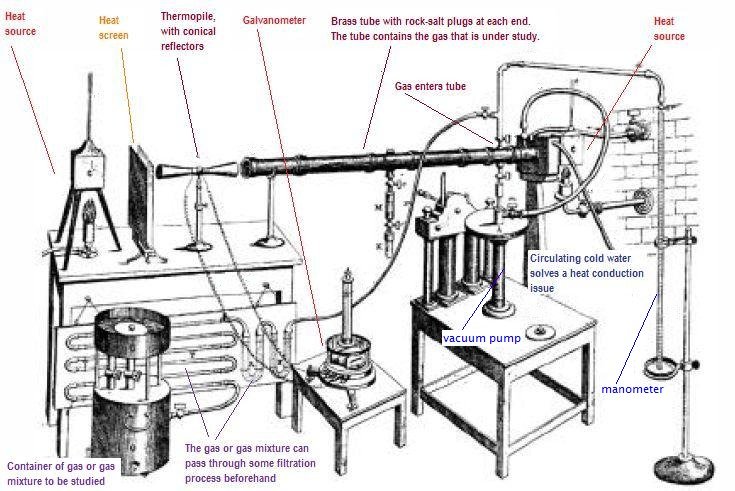
This is one of the early lab apparatus that measured radiant heat absorption of various gasses.
John TyndallFRS (2 August 1820 – 4 December 1893) was a prominent 19th century physicist. His initial scientific fame arose in the 1850s from his study of diamagnetism. Later he made discoveries in the realms of infrared radiation and the physical properties of air. Tyndall also published more than a dozen science books which brought state-of-the-art 19th century experimental physics to a wide audience. From 1853 to 1887 he was professor of physics at the Royal Institution of Great Britain in London.
John TyndallFRS (2 August 1820 – 4 December 1893) was a prominent 19th century physicist. His initial scientific fame arose in the 1850s from his study of diamagnetism. Later he made discoveries in the realms of infrared radiation and the physical properties of air. Tyndall also published more than a dozen science books which brought state-of-the-art 19th century experimental physics to a wide audience. From 1853 to 1887 he was professor of physics at the Royal Institution of Great Britain in London.
You're correct. I did not look at the article, because it is immaterial with regard to the question of whether anthro CO2 is affecting climate in a significant way. I just now looked at the article and I see I was entirely justified. Folks, a 0.7 deg increase (without any error limits by the way) for August is entirely meaningless in the grand scheme of things.Ha ha I know. It's like piehole did not even see this. And then he just mindlessly babbled on in an impressive display of bovine feces creation. He's literally unbelievable. LOL He probably cracks himself up as he writes the shit.
I'll put this here for him so maybe he sees it this time.
From the article...
"Data released by NASA's Goddard Institute for Space Studies on Monday shows that August 2014 was the warmest August worldwide since the instrument record began more than 130 years ago."
I am a scientist. Most of the rest of you are not. I understand that, and I accept things as they are.

This is one of the early lab apparatus that measured radiant heat absorption of various gasses.
Looks like Grade A s&m apparatus to me
This is one of the early lab apparatus that measured radiant heat absorption of various gasses.
John TyndallFRS (2 August 1820 – 4 December 1893) was a prominent 19th century physicist. His initial scientific fame arose in the 1850s from his study of diamagnetism. Later he made discoveries in the realms of infrared radiation and the physical properties of air. Tyndall also published more than a dozen science books which brought state-of-the-art 19th century experimental physics to a wide audience. From 1853 to 1887 he was professor of physics at the Royal Institution of Great Britain in London.
I am always amazed at what these early investigators accomplished with the little they had to work with. How smart and clever they were! What is that other heat source for. It is clearly his reference source. And how did he know that NaCl was transparent to IR? Those gas filter tubes. Those are to remove moisture from his gas. These guys: Tyndal, Faraday, Crookes, Eugen Goldstein, JJ Thomson (he was part of the golden age too, and what tremendous contributions, even surpassing Einstein in the value of his contributions!, and the many brilliant young minds he launched into careers in physics.), and a number of others. (Oh, Maxwell, let us not forget him, and Newton Too.) They made the golden age of science, the period from the 1890 through about 1929, possible. All of modern science owes a great debt to these guys. Mostly physical contributions, but chemistry was also developing in parallel at the same time. It would have been a very exciting time to be a participant in the Royal Society of London and read the Philosophical Transactions, the worlds first science journal, which the Society originated.
Last edited: