
You are using an out of date browser. It may not display this or other websites correctly.
You should upgrade or use an alternative browser.
You should upgrade or use an alternative browser.
Which way? Investing.
- Thread starter themickey
- Start date


Copper to Gold Ratio
https://www.longtermtrends.net/copper-gold-ratio/
Gold is the most widely recognized safe-haven asset among investors. Therefore, during times of economic and geopolitical distress it generally tends to perform well, making it a leading indicator of fear.
Copper is the exact opposite. Because it is a key industrial metal that is used globally in a wide range of industrial applications, it performs strongly when the global economy is firing on all cylinders. This makes it a leading indicator of global economic health and has led to it being commonly called Dr Copper.
The copper to gold ratio is a measure that compares the price of copper to the price of gold. It is calculated by dividing the current price of copper per ounce by the current price of gold per ounce.
The copper to gold ratio, a metric used to assess the relationship between the prices of these two metals, serves as a valuable tool for investors and analysts. By dividing the prevailing price of copper per ounce by the prevailing price of gold per ounce, this ratio provides insights into the relative value of copper compared to gold at any given time. A higher copper to gold ratio signifies that copper is relatively more expensive compared to gold, suggesting increased industrial demand and a positive outlook for economic growth. This scenario often reflects a strong and vibrant global economy, where demand for copper-driven industries is thriving. On the other hand, a lower copper to gold ratio may indicate a flight to safety and a more cautious sentiment prevailing in the market. During such times, investors tend to seek the relative stability of gold, perceiving it as a reliable asset in times of economic uncertainty.
A long-term price chart of the two reveals two things: First, Gold and Copper tend to move in the same direction a majority of the time. Second, it shows that the copper market tends to be more volatile and sensitive to price swings than gold. It makes sense that copper reacts to fundamental trends more quickly than gold. Copper is used explicitly for industrial consumption. More than two-thirds of the world’s red metal goes directly into building construction and electronics. The value of gold is much more likely to be shaped by interest rates and inflation expectations (rather than by noticeable swings in actual production and consumption) because most of of the gold in the world simply gets stored and transferred back and forth from one vault to the next.
Interestingly, the Copper to Gold Ratio correlates strongly with the 10-year US Treasury Bond Yield.
Higher interest rates may shift investor preferences away from gold towards income-generating investments such as bonds, causing the copper to gold ratio to rise.
When interest rates fall and assets such as bonds stop yielding returns, investors may seek alternative safe-haven assets like gold, causing the ratio to fall.
However, the copper-to-gold ratio is often regarded as a leading indicator for interest rates. When the ratio is rising, it suggests increased demand for copper, driven by higher economic growth. According to simple macroeconomic models, an increase in real gross domestic product will cause an increase in average interest rates in an economy.
https://www.longtermtrends.net/copper-gold-ratio/
Gold is the most widely recognized safe-haven asset among investors. Therefore, during times of economic and geopolitical distress it generally tends to perform well, making it a leading indicator of fear.
Copper is the exact opposite. Because it is a key industrial metal that is used globally in a wide range of industrial applications, it performs strongly when the global economy is firing on all cylinders. This makes it a leading indicator of global economic health and has led to it being commonly called Dr Copper.
The copper to gold ratio is a measure that compares the price of copper to the price of gold. It is calculated by dividing the current price of copper per ounce by the current price of gold per ounce.
The copper to gold ratio, a metric used to assess the relationship between the prices of these two metals, serves as a valuable tool for investors and analysts. By dividing the prevailing price of copper per ounce by the prevailing price of gold per ounce, this ratio provides insights into the relative value of copper compared to gold at any given time. A higher copper to gold ratio signifies that copper is relatively more expensive compared to gold, suggesting increased industrial demand and a positive outlook for economic growth. This scenario often reflects a strong and vibrant global economy, where demand for copper-driven industries is thriving. On the other hand, a lower copper to gold ratio may indicate a flight to safety and a more cautious sentiment prevailing in the market. During such times, investors tend to seek the relative stability of gold, perceiving it as a reliable asset in times of economic uncertainty.
A long-term price chart of the two reveals two things: First, Gold and Copper tend to move in the same direction a majority of the time. Second, it shows that the copper market tends to be more volatile and sensitive to price swings than gold. It makes sense that copper reacts to fundamental trends more quickly than gold. Copper is used explicitly for industrial consumption. More than two-thirds of the world’s red metal goes directly into building construction and electronics. The value of gold is much more likely to be shaped by interest rates and inflation expectations (rather than by noticeable swings in actual production and consumption) because most of of the gold in the world simply gets stored and transferred back and forth from one vault to the next.
Interestingly, the Copper to Gold Ratio correlates strongly with the 10-year US Treasury Bond Yield.
Higher interest rates may shift investor preferences away from gold towards income-generating investments such as bonds, causing the copper to gold ratio to rise.
When interest rates fall and assets such as bonds stop yielding returns, investors may seek alternative safe-haven assets like gold, causing the ratio to fall.
However, the copper-to-gold ratio is often regarded as a leading indicator for interest rates. When the ratio is rising, it suggests increased demand for copper, driven by higher economic growth. According to simple macroeconomic models, an increase in real gross domestic product will cause an increase in average interest rates in an economy.
Copper-gold ratio suggests recession ahead
MINING.COM Staff Writer | May 23, 2023 |Intelligence Markets Europe USA Copper Gold
https://www.mining.com/copper-gold-ratio-suggests-recession-ahead/

Stock image.
The Gundlach ratio, named for famed money manager Jeffrey Gundlach who closely watches the relationship between copper and gold, is trading near the lowest levels since the start of 2021, signalling that a recession might be looming.
Changes in the measure are a barometer of investor sentiment and the comparison has historically been a proxy for nominal interest rates and future economic growth, with a falling ratio consistent with rates flat to down.
Institutional asset managers also use the copper–gold ratio as one of the 10-year Treasury yield’s leading indicators.
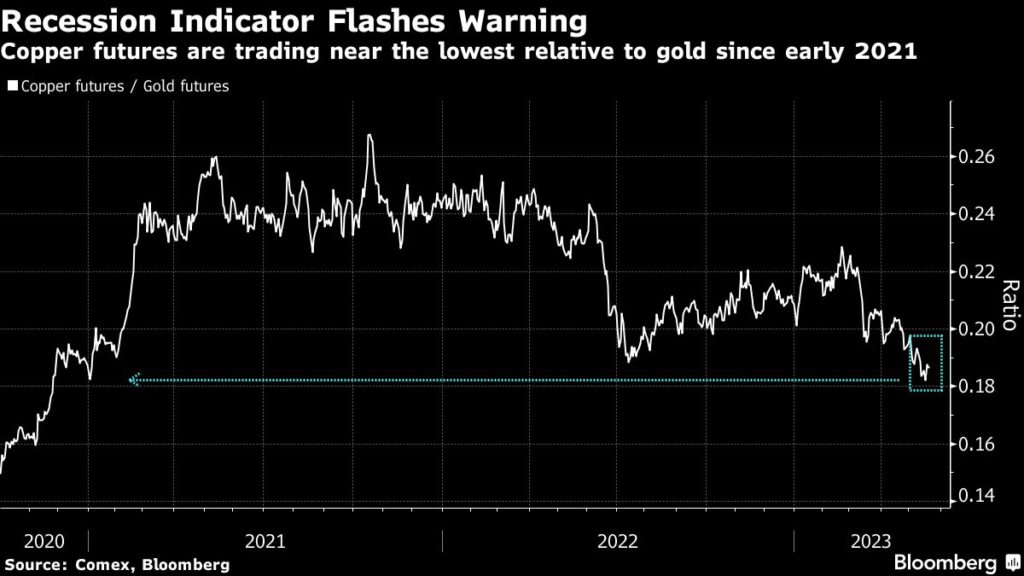
Copper prices touched a near six-month low on Tuesday as speculators boosted bearish positions amid worries about recession and weak demand in China.
Copper for delivery in July was down 0.7% on the Comex market in New York, touching $3.65 per pound ($8,030 per tonne).
“The short-term outlook has deteriorated with recession risks in Europe and the U.S., and a Chinese recovery that has not been commodity intensive,” said Ole Hansen, head of commodity strategy at Saxo Bank, Copenhagen.
Gold is up over 9% this year on demand for safe haven assets.
In March, Gundlach said a recession could happen within the next four months, mentioning how the recent US bank failures have exacerbated the tightening of financial conditions caused by higher borrowing rates.
“There’s is obviously financial fragility in Europe and the United States is also trying to cause a recession,” Gundlach told CNBC in a recent interview.
(With files from Reuters and Bloomberg)
MINING.COM Staff Writer | May 23, 2023 |Intelligence Markets Europe USA Copper Gold
https://www.mining.com/copper-gold-ratio-suggests-recession-ahead/
Stock image.
The Gundlach ratio, named for famed money manager Jeffrey Gundlach who closely watches the relationship between copper and gold, is trading near the lowest levels since the start of 2021, signalling that a recession might be looming.
Changes in the measure are a barometer of investor sentiment and the comparison has historically been a proxy for nominal interest rates and future economic growth, with a falling ratio consistent with rates flat to down.
Institutional asset managers also use the copper–gold ratio as one of the 10-year Treasury yield’s leading indicators.
Copper prices touched a near six-month low on Tuesday as speculators boosted bearish positions amid worries about recession and weak demand in China.
Copper for delivery in July was down 0.7% on the Comex market in New York, touching $3.65 per pound ($8,030 per tonne).
“The short-term outlook has deteriorated with recession risks in Europe and the U.S., and a Chinese recovery that has not been commodity intensive,” said Ole Hansen, head of commodity strategy at Saxo Bank, Copenhagen.
Gold is up over 9% this year on demand for safe haven assets.
In March, Gundlach said a recession could happen within the next four months, mentioning how the recent US bank failures have exacerbated the tightening of financial conditions caused by higher borrowing rates.
“There’s is obviously financial fragility in Europe and the United States is also trying to cause a recession,” Gundlach told CNBC in a recent interview.
(With files from Reuters and Bloomberg)

For investing purposes and momentum traders this could be interesting.
https://www.quantifiedstrategies.com/nordic-stock-markets/
https://www.quantifiedstrategies.com/nordic-stock-markets/

I'm placing this theme in Journals, it's really about investing ideas, long term wealth creation, these just musings which I will add to from time to time.
Mods may wish to move if they do not approve.
Do you have any idea how much it costs to produce an actual research report that predicts market moves before they actually happen, also known as timing the markets which the world deems is impossible, I actually posted some intraweek trades a few months back that hit the profit targets, but when it comes to investment grade that's where the real money comes in.
This is a 2020 XAUUSD Gold trade for +10% in one month.
This is the 2020 Dollar Index hitting the 104 TP to perfection last year (for hedging).
Why such old charts, because that is how it works for retail, either everyone is guessing due to lack of experience and technology and low targets -or- they get to know after it already happened from those that did know along the lines of you get what you pay for in life
