
I don't know enough about the stuff to comment on it authoritatively, but I do know to avoid them. They may have application for specific medical conditions, but to do either or both just for "the look" is a short-sighted approach to life. I did read, however, that HGH on its own does very little. However, when it is combined with steroids there is apparently a synergistic effect greater than the sum of its parts. The downside is that the internal organs also enlarge with the combination, giving way to the bloated look. So I don't know what either of the septuagenarians are on, but I'd bet my lunch money they're on something.Not an expert but reading the opinions on him yesterday, my take away is that there are 2 ways to go:
1. HGH
2. Steroids
Both can be legitly prescribed to an aging guy. The problem with T boosters like steroids is that once you are on it, you pretty much have to take it for life, because your body get used to it and if you stop you drop below previous non-steroid levels. Some says it is possible to wain off carefully but the jury is still out on that.

You are using an out of date browser. It may not display this or other websites correctly.
You should upgrade or use an alternative browser.
You should upgrade or use an alternative browser.
Muscle loss in old age linked to fewer nerve signals
- Thread starter Frederick Foresight
- Start date

A very good article explaining the differences and advantages:
http://anabolic.co/genetics/growth-hormones/hgh/hgh-vs-steroids/
Basically HGH is the "fountain of youth" and it is quite natural. Lots of 50+ men opt for it for health reasons...
http://anabolic.co/genetics/growth-hormones/hgh/hgh-vs-steroids/
Basically HGH is the "fountain of youth" and it is quite natural. Lots of 50+ men opt for it for health reasons...

I am not sure if we can get legally the right levels of HGH required to truly have the desired effect. Most HGH in the market is diluted watered down supplements.

This is interesting but if the researchers didn't properly control for confounding variables like activity/inactivity, nutrition and hormone levels (which themselves are interrelated), what the article claims is cause ("loss of nerves") may be more effect.http://www.bbc.com/news/health-43347409
Researchers say they may have worked out why there is a natural loss of muscle in the legs as people age - and that it is due to a loss of nerves.
In tests on 168 men, they found that nerves controlling the legs decreased by around 30% by the age of 75.
This made muscles waste away, but in older fitter athletes there was a better chance of them being 'rescued' by nerves re-connecting.
The scientists published their research in the Journal of Physiology.
As people get older, their leg muscles become smaller and weaker, leading to problems with everyday movements such as walking up stairs or getting out of a chair.
It is something that affects everyone eventually, but why it happens is not fully understood.
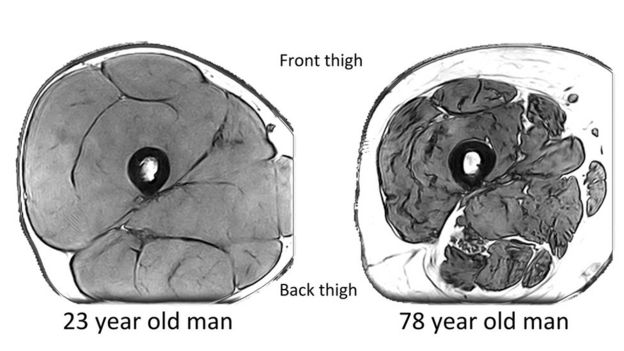
Muscle loss: The femur bone is in the middle creating a black ring, muscles are shaded grey and fat is white.
Prof Jamie McPhee, from Manchester Metropolitan University, said young adults usually had 60-70,000 nerves controlling movement in the legs from the lumbar spine.
But his research showed this changed significantly in old age.
"There was a dramatic loss of nerves controlling the muscles - a 30-60% loss - which means they waste away," he said.
"The muscles need to receive a proper signal from the nervous system to tell them to contract, so we can move around."
The research team from Manchester Metropolitan University worked with researchers from the University of Waterloo, Ontario, and the University of Manchester.
They looked at muscle tissue in detail using magnetic resonance imaging (MRI) and they recorded the electrical activity passing through the muscle to estimate the numbers and the size of surviving nerves.
The good news is that healthy muscles have a form of protection: surviving nerves can send out new branches to rescue muscles and stop them wasting away.
This is more likely to happen in fit people with large, healthy muscles, Prof McPhee said.
Although it is not known why connections between muscles and nerves break down with age, finding out more about muscle loss could help scientists find ways of reversing the condition in the future.
Related reading:
Physical activity in older age: perspectives for healthy ageing and frailty
https://www.ncbi.nlm.nih.gov/pmc/articles/PMC4889622/
Physical activity and telomere length: Impact of aging and potential mechanisms of action
https://www.ncbi.nlm.nih.gov/pmc/articles/PMC5546536/
Nutritional determinants of frailty in older adults: A systematic review
https://www.ncbi.nlm.nih.gov/pmc/articles/PMC5433026/
Hormones and Sarcopenia
https://www.ncbi.nlm.nih.gov/pubmed/27881060
Hormones are behind hernias of the groin in elderly men, study suggests
https://www.endocrine.org/news-room...as-of-the-groin-in-elderly-men-study-suggests
Frailty in the elderly appears in close association with chronic inflammation, and most of the published studies show a correlation between CRP and this clinical entity in older individuals.
https://www.ncbi.nlm.nih.gov/pmc/articles/PMC5412518/