You are using an out of date browser. It may not display this or other websites correctly.
You should upgrade or use an alternative browser.
You should upgrade or use an alternative browser.
[Amazing] Cave paintings: Up to 40,000 years Old
- Thread starter OddTrader
- Start date


http://www.independent.co.uk/news/w...ns-access-to-threatened-cave-art-2077575.html
The 900 images of aurochs (extinct ancestors of domestic cattle), wild horses, bison and ibexes – some at rest, some running or jumping – were painted between 15,000 and 18,000 years ago. Hunter-gatherers crushed minerals to create paints in red, ochre, brown and black. Whether the site was of religious or social importance is unknown.
Following a visit to the caves soon after their discovery, Pablo Picasso, known for the simplicity and purity of his brush-strokes, declared: "We have invented nothing."
Lascaux was closed to the public in 1963 to protect the caves from just the kind of fungal infections which have appeared in the last nine years. In 1983, a complete life-sized facsimile of the caves and paintings – Lascaux Two – was opened nearby. Some scientists fear that the success of this building – which attracts 250,000 visitors a year – may have disturbed the micro-climate in the original caves
In February 2009, Unesco threatened to humiliate France by placing Lascaux on its list of endangered sites of universal importance. This followed a series of botched, and then partially successful, attempts to fight off first white, and then ugly grey and black fungi, which began to creep over the paintings in 2001.
https://www.tripadvisor.com.au/Attr...II-Montignac_Dordogne_Nouvelle_Aquitaine.html
“Wonderful museum”
Lascaux [1, 2 & 4, with 3 being the touring exhibition, now just known as Lascaux] is one of the great museums. The building itself is strikingly contemporary, beautiful and also... read more
4 of 5 bubblesReviewed 23 January 2017
P1263LOchris
, Bakewell, United Kingdom
“This is the cave to visit”
5 of 5 bubbles Reviewed 6 February 2017
There are quite a few caves in the Vézère valley that boast prehistoric cave paintings. Lascaux II is the cave to see. You go to the others because the paintings are prehistoric. You go to Lascaux II because the paintings are extraordinary. After seeing Lascaux, Pablo Picasso is said to have muttered: ‘We have invented nothing’. I'm not sure that's...
https://archaeology-travel.com/france/lascaux-ii/
Lascaux II is a replica of the cave of Lascaux – the most well known Stone Age cave art site in Europe, if not the world.
...
Facilities & Visiting Lascaux II:
Lascaux II is open all year round (except for three weeks in January). From 1 October to Easter, you can buy your entry tickets at the ticket office onsite (except Mondays, when the site is closed). From Easter to the end of September Lascaux II is open every day, and timed tickets need to be purchased in the town of Montignac, at the place du cinéma, in the Office de Tourisme, opposite a church. Tickets can now be bought for the following day, or two. In fact in peak seasons, you would be very lucky to be able to buy a ticket for the same day.
Entry is via a guided tour only, which last about 40 minutes. Guided tours are available in French, English, German, Dutch and Spanish.
Prehistoric Cave Art in France
A guide to caves, a replicas and museums of Ice Age art
https://archaeology-travel.com/thematic-guides/cave-art-in-france/

Last edited:
35,000 year-old Indonesian cave paintings suggest art came out of Africa
Ghostly hand markings and animals in Sulawesi caves are much older than thought, pushing back probable date for origin of art
https://www.theguardian.com/science/2014/oct/08/cave-art-indonesia-sulawesi
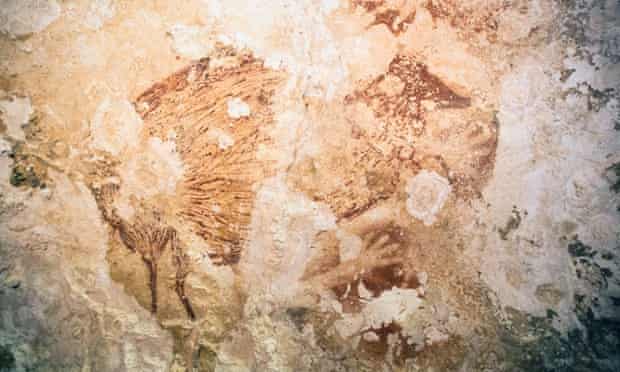
But fresh analysis of the pictures by an Australian-Indonesian team has stunned researchers by dating one hand marking to at least 39,900 years old, and two paintings of animals, a pig-deer or babirusa, and another animal, probably a wild pig, to at least 35,400 and 35,700 years ago respectively.
The work reveals that rather than Europe being at the heart of an explosion of creative brilliance when modern humans arrived from Africa, the early settlers of Asia were creating their own artworks at the same time or even earlier.